A label can carry the right serial number, barcode and company logo yet still fail its purpose if the adhesive is wrong. This guide to security label adhesives explains how to match adhesive performance to the asset, surface and operating conditions, so labels stay readable, traceable and difficult to remove without evidence.
For organisations managing IT equipment, tools, furniture, plant, laboratory devices or stock, adhesion is not a minor specification. It affects audit accuracy, loss prevention and the credibility of an asset register. The right construction also makes it clear when a seal has been lifted, replaced or interfered with.
What a security label adhesive needs to do
Security label adhesives are designed for more than simply holding a label in place. Depending on the application, they may need to form a long-term bond with metal, painted surfaces, plastics or textured equipment housings. They may also need to support a tamper-evident label face material that breaks apart or leaves a visible message when removal is attempted.
The best choice depends on the balance between permanence, initial tack, environmental resistance and tamper evidence. A very aggressive adhesive may be ideal for an outdoor asset label, but unsuitable for a temporary inspection seal or a delicate painted surface. Equally, a label that adheres well indoors on a smooth laptop may not perform on a low-energy plastic storage crate in an unheated warehouse.
It is useful to separate three elements of label performance. The face material provides the printed surface and may be polyester, vinyl or another specialist film. The adhesive creates the bond with the asset. The security feature provides evidence of removal, such as a destructible material or a VOID pattern. These elements work together, but they do not all solve the same problem.
Guide to security label adhesives by application
Permanent asset labels
Permanent asset labels are usually applied to equipment that remains on the register for years. Computers, monitors, AV equipment, machinery, furniture and tools all need labels that remain attached through handling, cleaning and day-to-day wear.
A permanent acrylic adhesive is commonly selected for this type of work. It provides good long-term adhesion to many smooth, clean surfaces, including powder-coated metal, aluminium, painted equipment and rigid plastics. When combined with durable polyester, it is a dependable choice for barcodes and serial numbers that must stay scannable over the life of the asset.
For most office and school environments, this is the practical starting point. The label should be applied to a flat, sheltered area where it will not be repeatedly rubbed by hands, cables, cases or moving parts.
Tamper-evident seals
A tamper-evident seal is intended to show that access has been attempted. It may be used on electrical enclosures, calibration points, cabinets, cases, packaging or restricted-access equipment.
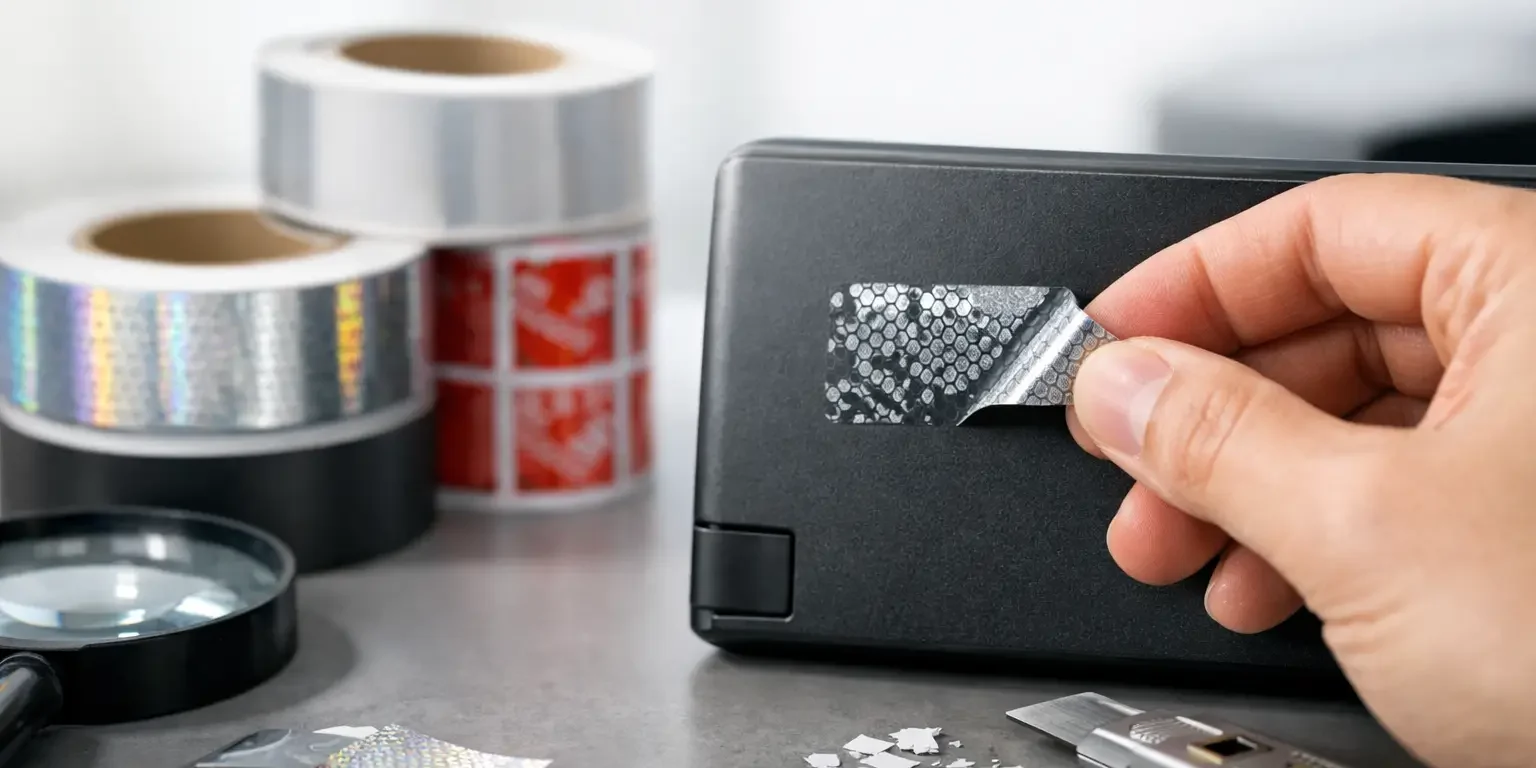
VOID labels use an adhesive and coating system that leaves a visible message on the surface, on the label, or both, when lifted. Destructible vinyl labels take a different approach: the label breaks into fragments if someone tries to remove it. Both are effective, but their suitability depends on the surface and the desired evidence.
VOID labels are often best on smooth, non-porous surfaces where the transferred pattern can be seen clearly. Destructible labels can be particularly useful where the label itself must not come away intact. Neither should be treated as a substitute for physical security, but both create a clear inspection point and can discourage casual interference.
High-tack labels for difficult surfaces
Not every asset has a clean, high-energy surface. Polypropylene and polyethylene plastics, often found on storage boxes, cases and industrial containers, can be difficult for standard adhesives. So can lightly textured coatings, rough plastic housings and surfaces exposed to dust or handling.
A high-tack adhesive provides stronger initial grab and is formulated to improve bonding on more challenging materials. It is often the better option for toolboxes, warehouse equipment and plastic containers, provided the label area can be cleaned and dried before application.
High tack is not a cure for poor preparation. If the surface is oily, damp, heavily textured or contaminated with silicone-based polish, even a specialist adhesive may fail. In these cases, select a smoother location on the asset or consider a different identification method alongside the label.
Labels exposed to heat, cold or outdoor conditions
Temperature affects both application and long-term performance. Labels applied in a cold store, unheated workshop or during winter transport may not achieve the bond expected from the same label applied at room temperature. Adhesive needs time and suitable contact with the surface to flow into microscopic gaps and build strength.
For outdoor equipment or assets stored in vehicles, the label construction should be selected for moisture, ultraviolet exposure and temperature cycling. The adhesive is only one part of the decision. A durable face material and suitable print protection matter just as much, particularly where barcode scanning is required.
If labels will be fitted in low temperatures, specify the application temperature as well as the service temperature. A label may withstand cold conditions after it has fully bonded, yet still be unsuitable for application in a cold environment.
Surface preparation determines adhesion
Most adhesion problems start before the label is applied. Production oils, dust, hand cream, wax, moisture and cleaning-product residue can prevent direct contact between adhesive and surface. A label may appear secure at first, then lift at the corners days later.
Clean the intended application area with a suitable lint-free wipe and allow it to dry fully. Isopropyl alcohol is frequently used for many hard surfaces, but it should be tested first where coatings, plastics or safety requirements are a concern. Avoid household cleaners that leave fragrance, polish or detergent residue.
Apply the label with firm, even pressure across the full surface, paying attention to corners and edges. Do not bridge a label over ridges, screws, mould lines or curves unless the material has been chosen for that purpose. Once applied, allow adequate dwell time before heavy handling, cleaning or exposure to demanding conditions. The bond generally strengthens over the first 24 hours.
Adhesive choice and barcode reliability
A barcode is only useful if it remains intact and scannable. Labels that lift, wrinkle or wear at the edges create avoidable problems during stocktakes and audits. For this reason, barcode labels should be specified as a complete construction rather than simply ordered by size.
Consider where the barcode will be scanned, how often it will be handled and whether staff use handheld scanners or mobile devices. A small barcode on a curved label may be technically correct but difficult to scan. Similarly, a highly reflective finish may be unsuitable in strong lighting conditions.
Serial numbers and QR codes can provide useful alternatives or additions, particularly where staff need to view more information from a mobile phone or tablet. However, the adhesive and material still need to keep the printed code stable for the required service life. A low-cost label that has to be replaced repeatedly is rarely the economical option.
Questions to ask before ordering
A clear brief avoids choosing an adhesive on guesswork. Before specifying security or asset labels, establish:
- What surface will the label be applied to: metal, paint, rigid plastic, low-energy plastic, glass or cardboard?
- Is the surface smooth, curved, textured, oily, powder-coated or regularly cleaned?
- Must the label remain permanently, or should removal leave visible evidence?
- Will the asset be used indoors, outdoors, in a vehicle, workshop, warehouse or temperature-controlled area?
- Does the label need a barcode, QR code, sequential serial number, logo or other variable data?
- What level of attempted removal needs to be deterred or detected?
The final question matters because no label is impossible to remove with enough time, tools or surface damage. The practical aim is to make unauthorised removal evident, inconvenient and easy to identify during inspection.
Common mistakes that reduce label performance
Ordering a standard permanent label for every item is tempting, especially across a mixed estate. It can work for straightforward office equipment, but it often creates issues when labels are applied to plastic cases, rough machinery or assets stored outdoors. Matching the label to the most demanding real-world conditions is usually the safer approach.
Another common mistake is applying labels immediately after an asset has been cleaned, painted or brought in from a cold vehicle. The surface may look dry while still carrying moisture, solvent residue or condensation. Allowing equipment to stabilise at a suitable temperature can prevent early failure.
Finally, do not place a security label where it can be removed with little effort and little visibility. Positioning should support the security purpose. A tamper seal should cross the point of access it is intended to protect, while an asset label should be visible enough for checks but protected from routine abrasion.
Security-Label.co.uk can advise on suitable label materials, adhesives, barcode formats and tamper-evident options before production, including bespoke layouts for individual asset management requirements. A short conversation about the surface and environment often prevents a costly re-labelling exercise.
The most dependable label programme starts with one practical decision: test the proposed label on the actual asset, in the actual working environment, before committing to a full run. That small check gives procurement teams, facilities managers and auditors far greater confidence that every label will do its job when it matters.