
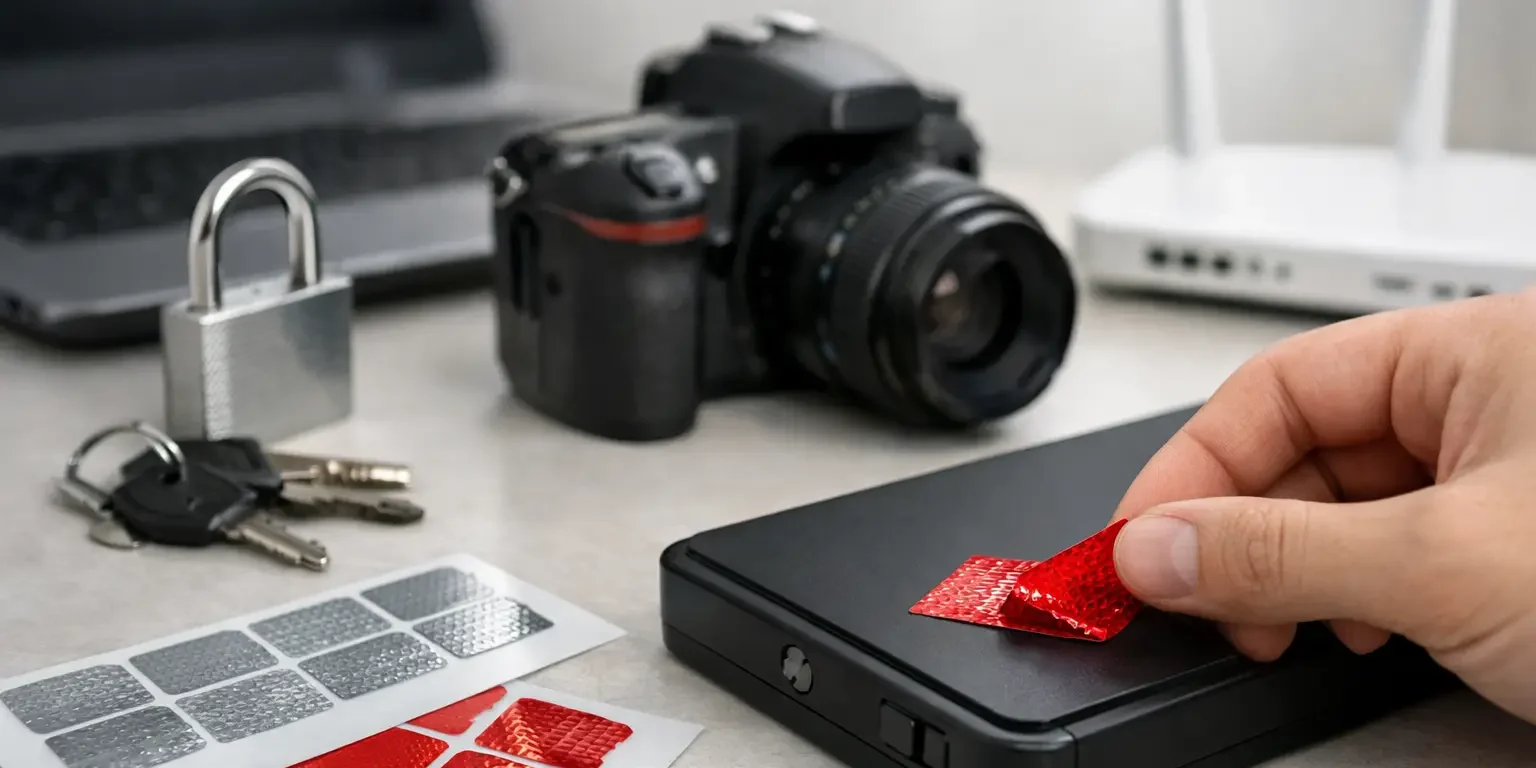
A missing laptop, projector or power tool is rarely just a replacement-cost problem. It creates downtime, uncertainty in the asset register and, in some cases, a difficult insurance or audit question. Security stickers for equipment give every item a visible identity, making it easier to trace, harder to dispose of anonymously and quicker to check in or out.
The right label does more than carry a company name. It must suit the surface, the working environment and the way your organisation records assets. A label that peels away after a few months, smudges under routine cleaning or cannot be scanned by your existing system will not provide the control you need.
Start with the job the label needs to do
Equipment labels are often expected to solve several different problems at once. A facilities team may need an asset number for annual checks, while IT needs a barcode for device records and finance needs proof that an item belongs to the organisation. In higher-risk areas, the label may also need to provide clear tamper evidence.
For basic identification, a durable asset label with a company name, contact number and unique serial number may be enough. This is common for office furniture, audiovisual equipment and low-value shared items. The visible marking alone can discourage casual removal and helps honest finders return misplaced property.
Where equipment is managed through a database, adding a barcode or QR code makes checks faster and reduces manual entry errors. The code should normally link to a unique asset ID rather than contain all of the item’s details. That keeps the printed layout clean and allows the record to be updated in your system without replacing the label.
For sensitive, portable or high-value equipment, choose a tamper-evident construction. These labels leave a visible pattern, wording or residue if somebody attempts to remove them. They do not physically stop theft, but they make unauthorised removal apparent and reduce the value of a stolen item to someone trying to pass it off as unmarked.
Choosing security stickers for equipment by surface
The adhesive is as important as the printed face. A label can look excellent when it leaves production but fail quickly if it is applied to the wrong material or to an unprepared surface.
Smooth, clean metal and hard plastic are the most straightforward applications. Most permanent asset labels adhere well when the surface is dry and free from dust, oil and polish. Wipe the area first, allow it to dry fully and apply firm, even pressure across the whole label. Corners are the first area to lift, so avoid placing labels across ridges, vents, screws or heavily curved sections where possible.
Textured plastic, powder-coated cabinets and painted equipment need more consideration. The uneven surface reduces the adhesive contact area, while some coatings contain additives that make adhesion difficult. Testing a small quantity before committing to a larger order is sensible, particularly for expensive equipment or specialist machinery.
For outdoor plant, tools and equipment exposed to moisture, abrasion or temperature changes, standard paper labels are not suitable. A durable synthetic material with a protective laminate is usually the better choice. The label should resist water, dirt, sunlight and routine wiping, while retaining a readable barcode. A thick label is not automatically best, however. Very rigid materials may struggle on curved surfaces, so the equipment shape still matters.
Heat, cleaning chemicals and handling
Think about how equipment is actually used rather than where it is stored. A label on a school laptop trolley faces different conditions from one on a warehouse scanner, a laboratory device or a construction tool.
Frequent use causes edge wear. Alcohol wipes and cleaning chemicals can affect inks or coatings. Heat can soften some adhesives, while cold conditions can make application harder. Share these details when specifying labels, including the expected temperature range and whether the item is cleaned with disinfectant. A suitable material and overlaminate can prevent a small purchasing decision becoming a recurring relabelling task.
Make the data useful at the point of use
An equipment sticker must be readable in the moment it is needed. That applies to people and scanners alike. Overcrowding the label with logos, terms, telephone numbers and technical codes can make the key asset identifier difficult to find.
For most organisations, the priority order is simple: a clear asset number, a scan code where required, ownership details and a short theft-deterrent message. If the label includes a barcode, print the human-readable number beneath it. Staff can still identify the item if a scanner is unavailable or the barcode is damaged.
Barcode format should follow the system you already use. Code 128 is a common choice for alphanumeric asset numbers because it is compact and widely supported. QR codes are useful where staff scan with mobile devices or need to open an asset record, instruction page or reporting form. Neither format is inherently better. A QR code can hold more data, but a conventional barcode may be quicker and more practical for an established handheld-scanner workflow.
Serial numbering is particularly valuable for organisations building or improving an asset register. Sequential numbering provides a straightforward audit trail and makes missing numbers easier to spot. If you already have internal IDs, the label should match them exactly. Avoid creating a second numbering system unless there is a clear plan for managing it.
Tamper evidence is a deterrent, not a substitute for control
Tamper-evident security labels are often chosen for laptops, desktop computers, servers, medical devices, test equipment and rented equipment. Once removed, the face material may fragment, show a checkerboard pattern or leave behind words such as VOID. The appropriate option depends on the surface and the level of evidence required.
Destructible labels are designed to break into small pieces when removal is attempted. They work well where it is acceptable for the label to be sacrificed and where the surface is smooth. Void labels provide a clearer visual indication of removal, but the residue or pattern they leave must be compatible with the equipment finish. On some surfaces, especially certain plastics or coatings, residue may be undesirable.
Tamper evidence should support wider procedures. Keep an up-to-date register, record who holds portable devices, restrict access to storage areas and investigate labels that show signs of interference. A label makes a problem visible; the process around it determines what happens next.
Avoid the common ordering mistakes
Size is often overlooked. Small labels are discreet and economical, but they limit the amount of readable information and reduce barcode scan tolerance. Larger labels are easier to scan and more visible as a deterrent, yet may not fit neatly on compact devices. Measure the intended application area, allowing clearance from ports, safety markings and manufacturer serial plates.
Colour can improve recognition, particularly when labels distinguish departments, sites or ownership status. High contrast is more useful than decorative design. Black text on a light background is generally easy to read, while a strong colour band or company logo provides immediate visual ownership. If labels are used outdoors, consider how the colour will age in sunlight.
Do not assume every item needs the same label. A single organisation may need compact labels for IT equipment, larger barcode labels for furniture and tamper-evident seals for restricted cabinets. Using one general-purpose sticker everywhere can appear cheaper initially, but it often leads to poor fit, failed adhesion or labels that do not provide the required evidence.
A practical specification before you order
A clear specification speeds up production and avoids surprises. Confirm the label dimensions, quantity, material, adhesive requirement, print colours and whether numbering, barcodes or QR codes are variable. Provide the data in a clean spreadsheet where possible, with one asset record per row. Check number ranges carefully before approval, especially when labels are being matched to an existing register.
Ask for advice if the label will be fitted to an unusual surface, used outside or exposed to chemicals. Security-Label.co.uk produces labels in the UK and can advise on bespoke layouts, barcode formats and tamper-evident options before production. That specialist input is particularly useful when a label must work first time across a large estate of equipment.
The most effective equipment label is one staff can apply correctly, read quickly and trust to stay in place. Specify it around the equipment, the environment and your working process, then it becomes a small but dependable part of stronger asset control.