
A missing laptop is rarely just a missing laptop. It may contain sensitive information, delay a member of staff, trigger an insurance question and expose gaps in the asset register. RFID asset tracking gives organisations a quicker way to identify what they own, where it was last recorded and whether it is where it should be.
For schools, offices, hospitals, warehouses and multi-site businesses, the attraction is clear: assets can be identified without scanning every individual barcode at close range. But RFID is not a cure for poor records or unsuitable labels. The result depends on choosing the right tag, reader setup and process for the equipment being tracked.
What is RFID asset tracking?
RFID stands for radio-frequency identification. An RFID label or tag contains a small chip and antenna which stores a unique identifier. When the tag passes within range of a compatible reader, the reader captures that identifier by radio signal.
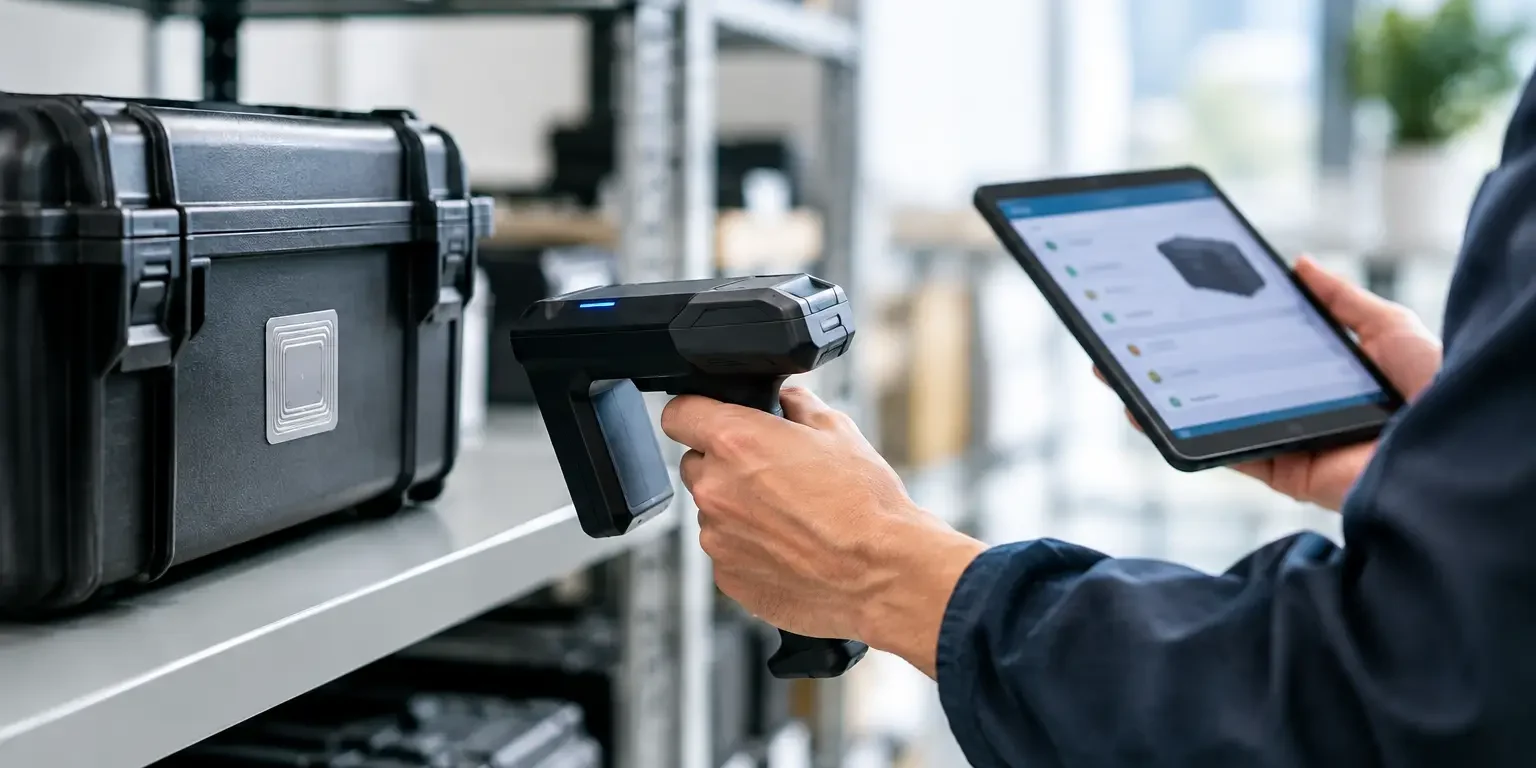
In practical terms, each asset is assigned a unique record in an asset management system. The RFID tag links the physical item to that record. A team can then use a handheld reader, fixed doorway reader or desktop scanner to locate, check or audit tagged equipment.
Unlike a barcode, RFID does not always require a direct line of sight. A reader may capture multiple tags in a cabinet, on a trolley or in a room during a single scan. That makes it particularly useful where organisations hold large numbers of similar, movable assets such as IT equipment, tools, medical devices, library stock or reusable containers.
The tag itself does not usually provide GPS-style live location. Standard RFID asset tracking records an item when it is read at a known place and time. If you need continuous, room-by-room location information, you may need a more extensive active RFID or real-time location system. That brings higher hardware, installation and maintenance costs.
When RFID makes commercial sense
RFID works best where the cost of manual checks, missing equipment or repeated stock discrepancies is greater than the cost of the system. A business with 30 fixed desktop PCs may find durable serialised asset labels and barcode scanning entirely sufficient. A university managing thousands of laptops, projectors and specialist devices across several buildings may save considerable time through RFID audits.
The strongest case is often routine verification. Instead of reading labels one at a time, staff can walk through an area with a handheld reader and compare detected assets against the expected list. This helps identify equipment that has moved, has not been returned or has never been registered correctly.
RFID can also support controlled movement. Tags read at a store entrance, issue point or secure exit can create a record of equipment leaving or entering an area. It is a useful accountability measure, although it should be supported by clear issue procedures and named responsibility. A reader can tell you that a tag was detected. It cannot explain whether the movement was authorised unless your process captures that information.
RFID labels versus barcode asset labels
Barcode labels remain a sensible choice for many UK organisations. They are economical, easy to print, widely compatible and straightforward for staff to use with mobile phones or standard scanners. A barcode is visible, which can also make it easier to identify an individual item during a desk-based audit.
RFID has a different advantage. It speeds up bulk reads and can capture tags that are not directly visible, subject to the material, reader and environment. It is well suited to high-volume audits and locations where handling every item would take too long.
Many organisations use both. A combined RFID and barcode label gives each asset a readable printed identifier alongside its electronic tag. The barcode provides a dependable fallback for close-range checks, while the human-readable serial number helps staff resolve exceptions quickly. Including a company name, asset number and return instruction can further improve recovery if an item is misplaced.
This combined approach is often more practical than relying on technology alone. When a tag is damaged, a barcode may still be readable. When a scanner battery is flat or a reader is unavailable, staff are not left without an identification method.
Choosing the right RFID asset label
The label must suit the asset and its working environment. The cheapest tag is not necessarily the most affordable option if it lifts, cracks or fails to read after a few months.
Standard paper labels are rarely appropriate for valuable equipment or long-term asset identification. For office furniture, laptops and electrical equipment, a durable synthetic label with a permanent adhesive is normally a better starting point. Polyester is widely used because it resists scuffing, moisture and everyday cleaning.
Metal creates a particular challenge. Standard RFID tags can perform poorly when attached directly to metal surfaces because the metal affects the radio signal. On-metal RFID labels are designed with a suitable construction to maintain read performance on metal cases, cabinets, tools and machinery. They usually cost more, but they avoid a common and frustrating installation failure.
Curved, textured, hot, oily or outdoor surfaces also need careful consideration. A label that performs well on a smooth laptop casing may not adhere properly to a powder-coated tool, a rough plastic container or equipment exposed to weather. Test samples on representative assets before committing to a large order.
For higher-risk equipment, consider whether tamper evidence is needed alongside RFID. A destructible or void-producing security label can show clear evidence if somebody attempts to remove the tag. This does not make theft impossible, but it increases deterrence and makes unauthorised label removal more visible during checks.
Plan the data before ordering tags
An RFID project often succeeds or fails on the quality of its data, not the radio technology. Every tag needs a unique identifier that corresponds to one accurate asset record. Duplicated numbers, missing serial numbers and inconsistent descriptions quickly undermine the value of faster scanning.
Decide which fields are essential before labels are produced. In most cases, this includes an internal asset ID, equipment type, manufacturer serial number, assigned department or user, purchase date and status. Keep the printed information concise. The RFID chip can carry a unique code, while the main system holds the fuller record.
It is also worth agreeing how staff will label equipment. A consistent position helps with audits and makes labels easier to find. Avoid areas likely to be handled heavily, cleaned with abrasive products, covered by cases or damaged by opening and closing mechanisms. Do not place labels over ventilation slots, safety notices or manufacturer serial plates.
A practical rollout for RFID asset tracking
Start with a defined group of assets rather than trying to tag everything at once. A pilot involving high-value IT equipment or a single department will show how well labels read in real conditions and whether staff can follow the process.
Before rollout, test the tag on the actual materials being used. Check read distance, orientation, stacking effects and any interference from metal shelving, cabinets or power equipment. A tag that reads perfectly on a bench may behave differently when dozens of items are stored together.
Next, clean up the existing asset register. Reconcile duplicate entries, retire equipment that has been disposed of and confirm serial numbers where possible. Then apply labels, capture each RFID code and associate it with the correct record. This is the stage where accuracy matters most.
Train staff on the routine, not just the device. They need to know when to scan, what to do when an item is not detected and how to record transfers, repairs and disposals. Make exception handling simple. If staff cannot resolve a mismatch quickly, audits will become inconsistent again.
Finally, set a realistic audit schedule. High-value mobile equipment may justify monthly checks, while fixed furniture may only need annual verification. The right frequency depends on risk, movement and the consequences of loss.
Questions to ask before buying
A supplier should be able to help you specify labels around the assets and process, rather than simply offering a generic RFID sticker. Before ordering, establish whether the labels will be applied to metal, plastic or mixed surfaces; whether they need tamper evidence; which reader frequency and tag standard your system supports; and whether printed barcodes, serial numbers or branding are required.
It is equally useful to ask about label size, adhesive, expected service life and finish. Small labels can be discreet, but a very small antenna may reduce read range. Larger labels can improve performance but may not fit neatly on compact equipment. There is always a balance between appearance, durability and technical performance.
For organisations buying in the UK, local manufacture can make the specification process easier. It allows quicker proofing, practical material advice and faster replacement orders when an asset programme expands or label details change.
The best starting point is a small, properly tested batch matched to your equipment and readers. Once the labels, data and audit process work together, RFID becomes a practical control that saves time rather than another system for staff to manage.