
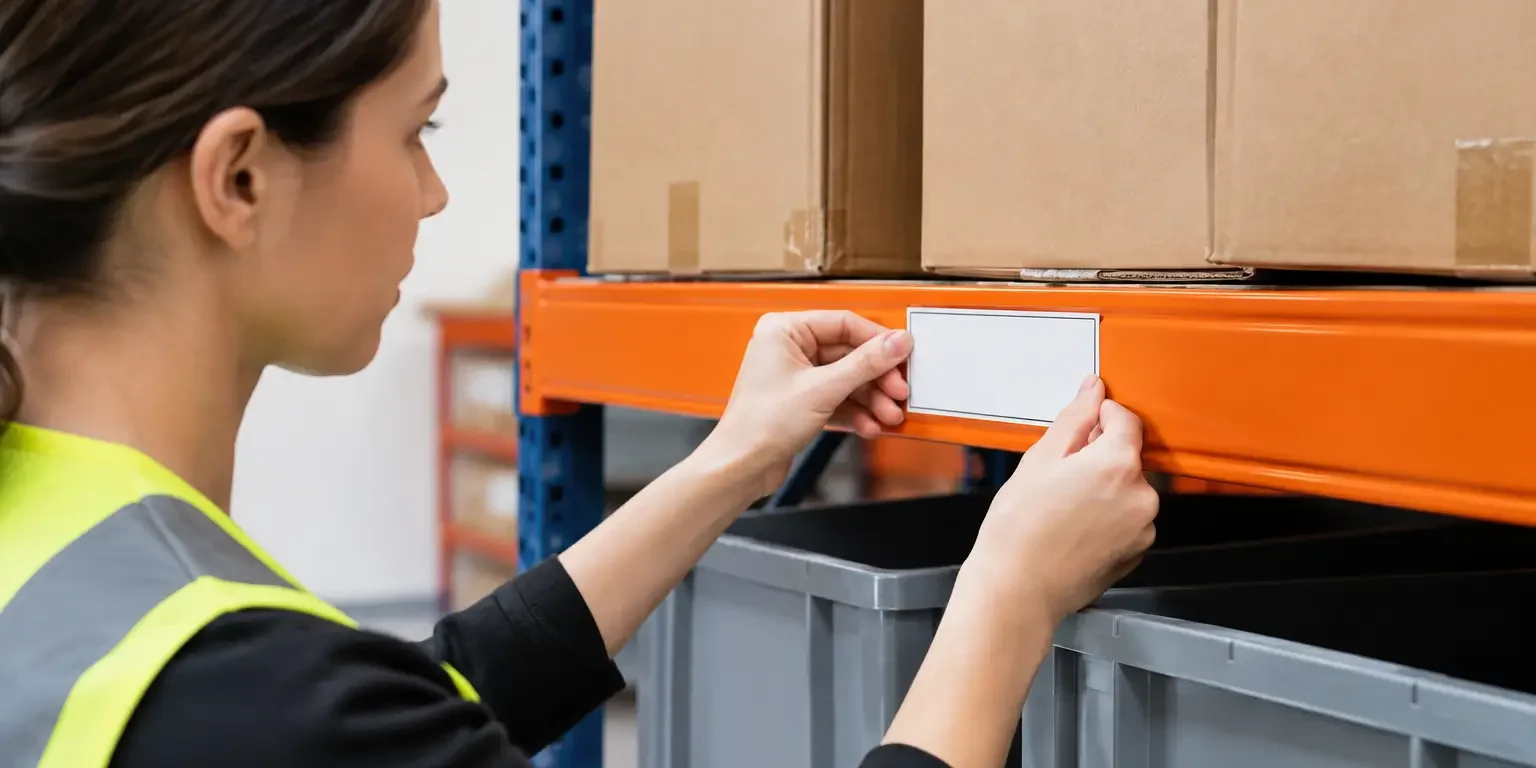
A missed pick is often blamed on the person with the scanner, but the problem may have started with an unclear location label. A well-planned guide to warehouse shelf labels starts with a simple aim: every operative should be able to identify the correct bay, level and pick face quickly, even in poor light, at height or under pressure.
Shelf labels are a working part of warehouse control, not a finishing touch. They support accurate receiving, put-away, replenishment, picking, stocktakes and audit trails. The right format also helps new staff learn the layout faster and reduces reliance on local knowledge.
Start with a location system that makes sense
Before choosing label material, agree the location code. A shelf label can only be as useful as the information behind it. Most warehouses use a hierarchy such as zone, aisle, bay, level and position. For example, A-03-12-B may identify zone A, aisle 03, bay 12 and shelf level B.
The exact structure depends on the building and warehouse management system. A small storeroom may only need aisle, rack and shelf. A distribution operation with multiple pick faces, bulk storage and temperature-controlled areas will usually need more detail. What matters is consistency. Do not use “Bay 4” in one area and “04” in another, or combine letters and numbers without a clear rule.
Keep codes short enough to read and enter manually, but specific enough to identify one physical location. Avoid characters that can be confused at a glance, particularly O and 0, I and 1, or S and 5. If staff must read a location from a forklift cab or a handheld terminal, clarity is more valuable than a clever coding system.
Separate location labels from stock labels
A shelf or rack label identifies where an item belongs. A stock label identifies what the item is. Treating these as separate labels prevents problems when product lines change. The location remains fixed while the stock at that position may be replenished, moved or discontinued.
Where pick faces need product information, use a secondary label or an insert that can be replaced without removing the permanent location identification. This is particularly useful for fast-moving consumables, spare parts and seasonal stock.
Make warehouse shelf labels easy to scan and read
A warehouse label should work in two ways: visually for people and electronically for scanners. The human-readable location code needs to be large, high contrast and positioned consistently. The barcode should match the code exactly, with no spaces, hidden characters or different abbreviations.
For many warehouse location systems, Code 128 is a practical barcode choice because it holds letters, numbers and punctuation in a compact symbol. Code 39 can also suit simpler alphanumeric applications, although it takes up more space. QR codes are useful where staff need to access extra information, such as handling instructions, photographs or a digital record, but they are not always the best replacement for a conventional linear barcode in a high-volume picking operation.
Barcode size is not a cosmetic decision. A code that scans perfectly from 10 centimetres away may fail at arm’s length or from a forklift. The available label area, scanner type, print quality and scan distance all affect performance. Leave a clear margin around the barcode, known as the quiet zone, and avoid placing it over ridges, joins or heavily textured surfaces.
If labels are scanned regularly, test a sample in the real environment before committing to a full order. Test it using the devices, lighting and scan distances your team actually uses. This small step can prevent a costly relabelling exercise.
Choose label materials for the environment, not just the price
Paper labels can be suitable for short-term stock identification in clean, dry internal areas. They are economical, but they are rarely the right choice for permanent shelf locations. Warehouse shelving is exposed to knocks, dust, cleaning, changing temperatures and abrasion from cartons, pallets and handling equipment.
For long-term location marking, synthetic labels are usually the more dependable option. Polyester provides strong tear resistance and good print durability, making it suitable for indoor racking, bins and shelving. Vinyl is more flexible and can be useful where the application surface is slightly uneven or curved. The adhesive matters just as much as the face material. A label applied to dusty, oily or very cold metal can fail regardless of how durable the printed face appears.
Consider the conditions around each storage area. Freezers, loading bays, outdoor cages and chemical stores may need a different specification from a clean parts room. If rack uprights are painted, powder-coated, galvanised or regularly wiped down, confirm adhesive compatibility before ordering. A specialist label manufacturer can advise on materials and adhesives when the application is unclear.
When tamper evidence is useful
Tamper-evident labels are not normally required for every shelf location. They do have a clear role where labels must not be moved or altered without visible evidence. This can apply to controlled stock, high-value components, evidence stores, IT spares, pharmaceutical areas or audited storage locations.
A destructible or void-style label can show that a label has been removed or interfered with. It is a deterrent as well as a control measure. However, it should be used selectively. If warehouse layouts change frequently, a permanent tamper-evident label may create unnecessary replacement work.
Get size, colour and placement right
Large labels improve visibility, but oversized labels can be vulnerable to peeling and may obscure rack safety information. Select a size that gives the location code enough prominence while fitting the available flat surface. In narrow aisles, labels are often placed on the outer end of the rack so they can be read before an operative enters the bay. For shelving, front-edge labels at a consistent height usually work best.
Colour can help staff distinguish zones, picking areas or storage types. For example, blue may identify returns, yellow may identify quarantine and green may identify released stock. Colour should support the code, not replace it. Some users will be colour-blind, lighting varies, and monochrome printouts may be used during audits.
Keep the design disciplined. A practical shelf label generally needs the location code, a barcode and, where needed, a short zone description or check digit. Too much text slows recognition. Company logos and internal references can be included, but operational information should remain the priority.
Plan installation as carefully as the label design
Labels applied to unprepared surfaces are a common cause of early failure. Before fitting, remove dust, grease and loose paint, then allow the surface to dry. Apply labels within the recommended temperature range, pressing firmly across the full area rather than just the corners.
Create a simple installation plan so labels are fitted in the same sequence as the location register. An off-by-one error on a row of bays can cause persistent mispicks that are difficult to trace. It is sensible to verify each location with a scanner as labels are installed, then carry out a second check against the warehouse layout.
For a larger roll-out, use this handover checklist:
- Confirm every printed code matches the approved location master.
- Scan a sample from each zone using normal warehouse equipment.
- Check that labels do not cover load notices, safety markings or rack inspection tags.
- Record the material, layout and barcode standard for future replacements.
- Keep spare labels for damaged locations and planned layout changes.
Maintain labels as part of normal warehouse control
Warehouse shelf labels need periodic inspection, particularly in busy pick areas. Look for lifting edges, faded print, damaged barcodes and labels obscured by stretch wrap, dust or temporary notices. Include label checks in regular housekeeping or rack inspection routines rather than waiting for a stock discrepancy.
When a location changes, update the warehouse system and physical label together. Changing only one creates a control gap. If a temporary move is unavoidable, use a clearly marked temporary label and assign responsibility for removing it once the permanent arrangement is restored.
Security-Label.co.uk produces bespoke barcode and durable identification labels in the UK, including layouts with sequential numbers, location codes and custom sizing. This can be particularly useful where standard off-the-shelf labels do not fit the rack, bin or scanning process.
The best shelf label is the one staff trust without having to think about it. Specify it for the actual warehouse, test it before roll-out and keep the physical locations aligned with the data behind them. That is how a modest label becomes a reliable control point for the whole operation.