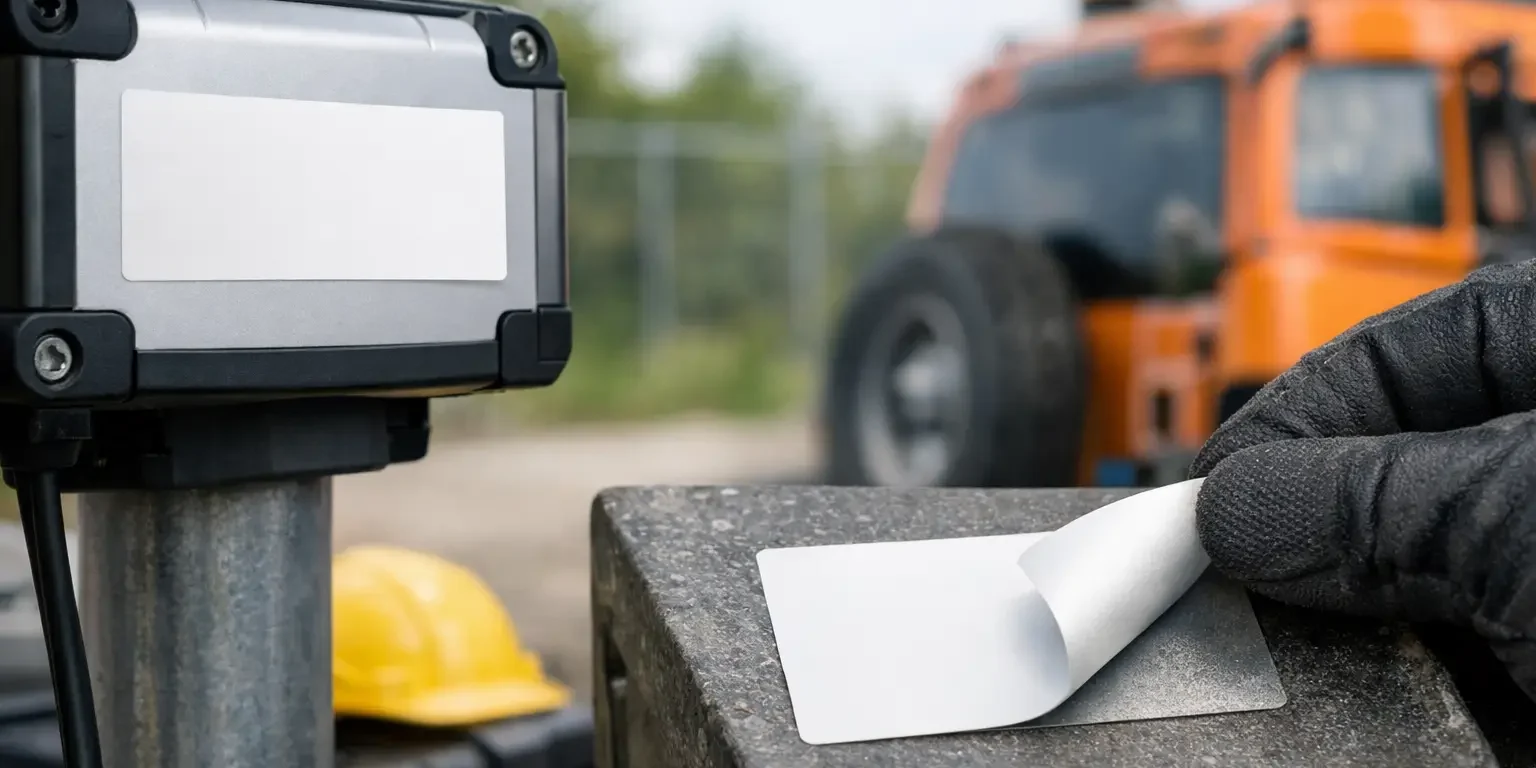
A label on a generator, grounds vehicle or external plant cabinet has a harder job than one on an office laptop. Rain, ultraviolet light, frost, cleaning chemicals and repeated handling can quickly make an unsuitable label peel, fade or become impossible to scan. Durable outdoor asset labels are designed to keep asset details readable and securely attached where standard paper or basic vinyl labels will not last.
For UK organisations, choosing the right specification is not simply a matter of ordering the toughest material available. The surface, exposure level, required lifespan and data on the label all affect the best choice. A label that performs well on smooth powder-coated equipment may fail on textured plastic, oily machinery or rough concrete.
Start with the real outdoor environment
Outdoor use covers a wide range of conditions. A label fixed inside a weatherproof cabinet faces very different risks from one applied to a hire tool, forklift, pump or electrical enclosure. Before selecting a material, consider where the equipment is kept, how often it is moved and what it comes into contact with.
Continuous sunlight is one of the main causes of fading. Where assets are left outside for long periods, a UV-resistant face material and protective overlaminate help preserve printed text, company logos and barcodes. Rain and humidity matter too, particularly where water can work into a poorly bonded edge. In coastal areas, salt-laden air can add another level of exposure.
Physical wear is equally relevant. Equipment handled by operatives, loaded into vehicles or cleaned regularly needs a surface that resists scratching and abrasion. For plant, tools and machinery, it is sensible to plan for knocks, fuel splashes, oil and cleaning fluids rather than specify for ideal conditions.
Choose durable outdoor asset label materials carefully
The right label is a combination of face material, adhesive, print method and protective finish. Each part needs to suit the application. A long-life film with the wrong adhesive is still likely to fail.
Polyester for long-term equipment identification
Printed polyester is commonly chosen for fixed outdoor assets because it offers good resistance to moisture, abrasion and everyday chemical contact. When supplied with a clear protective laminate, it provides a clean, professional finish while helping variable information remain legible.
It is particularly suitable for metal cases, electrical equipment, external cabinets and machinery with flat, clean surfaces. Polyester can carry serial numbers, sequential numbering, barcodes and QR codes without sacrificing clarity. It is a practical choice where the label needs to support an asset register over several years.
Vinyl for curved or uneven surfaces
Vinyl is more flexible than polyester and can be a better option for curved housings, wheelie bins, outdoor containers and certain plastic equipment. Its ability to conform is valuable, but flexibility is not the only deciding factor. A heavily textured or low-surface-energy plastic may still need a specialist adhesive and a test application.
For labels exposed to sun and weather, printed vinyl should be protected where appropriate. The material may suit the shape of the asset, while a laminate gives the printed area greater protection from scuffs and fading.
Metal-effect and specialist constructions
Some assets need a more permanent appearance or a label that supports a higher perceived level of security. Metal-effect polyester can be useful for durable identification plates without the cost and fixing requirements of engraved metal. For particularly demanding locations, specialist constructions may be required, especially where heat, aggressive chemicals or frequent pressure washing are involved.
There is no benefit in over-specifying every label. A high-performance construction costs more than a standard indoor label, so match the specification to the asset’s value, environment and expected service life. A short-term site asset and a permanent piece of infrastructure rarely need the same solution.
Adhesive performance begins before fitting
Even the best outdoor adhesive needs a suitable surface. Dust, oil, moisture, polish and loose paint all reduce bond strength. This is one reason labels sometimes appear to fail when the material itself is not the problem.
Apply labels to a clean, dry surface at a sensible temperature. Wipe away grease and dirt first, then allow the area to dry fully. Avoid fitting labels immediately after equipment has come in from the rain or after a wash-down. Pressure should be applied firmly across the whole label, with particular attention to the edges and corners.
Freshly painted equipment deserves extra care. Paint can continue releasing solvents after it feels dry, which may interfere with adhesion. Allow adequate curing time and test a sample where the finish is unfamiliar. The same approach is worthwhile for recycled plastics, textured powder coating and surfaces exposed to oils.
Keep barcodes and QR codes usable outdoors
Asset identification only works if staff can read it quickly. A faded code, a badly positioned label or a barcode that is too small for the scanner creates extra work and weakens audit control.
For conventional barcode scanning, Code 128 is often a sensible option for asset numbers because it holds letters and numbers efficiently. QR codes are useful where a scan needs to open a digital asset record, maintenance page or inspection form. The correct format depends on the software and devices already in use, not on which code looks more modern.
Print contrast matters. Dark data on a light background is normally easiest to scan, while glossy reflections can occasionally affect camera-based scanning in bright light. Leave clear space around the barcode or QR code and avoid placing it across a sharp curve, seam, handle or heavily worn edge. A larger label may cost slightly more but can prevent repeated scanning failures in the field.
Include human-readable text as well. A serial number, department name or asset reference gives staff a fallback when a handset is unavailable or a code has been damaged. For high-value equipment, a visible company name can also act as a straightforward theft deterrent.
Add tamper evidence where removal is a risk
Outdoor asset labels can identify equipment, but they can also discourage unauthorised transfer or resale. If labels may be removed to conceal ownership, a tamper-evident construction is worth considering.
Destructible materials break into fragments when someone attempts removal. Void labels leave a visible message on the asset surface and often within the lifted label. The best choice depends on the substrate and the level of evidence required. A void label gives a clear indication of interference, while a destructible label is difficult to remove in one piece.
Tamper evidence involves a trade-off. These labels are intended to show removal, so they are not designed for routine repositioning. They should be applied only once the asset number, location and ownership information have been checked. On rough outdoor surfaces, a sample test is particularly useful because tamper behaviour can vary with surface texture and paint finish.
Size and position labels for the people using them
A label can be technically durable yet operationally poor if it is hidden or difficult to scan. Choose a position that is visible during normal use but protected from direct abrasion where possible. On a generator, for example, a flat side panel may be better than a frequently handled access door or a panel close to the exhaust.
Small labels suit compact devices and can carry a serial number with a concise barcode. Larger assets allow more room for a logo, asset ID, barcode, safety instruction or contact detail. Avoid cramming too much information into a small area. Readability is more valuable than a label filled with details nobody can use at a glance.
If your organisation manages several asset categories, a consistent layout reduces mistakes. Keeping the asset number in the same position and using a standard barcode format makes stock checks, inspections and handovers faster for staff.
Order to a specification, not just a quantity
When requesting durable outdoor asset labels, provide the details that affect performance: the asset surface, likely weather exposure, required dimensions, quantity, data format and whether tamper evidence is needed. If labels must work with an existing register, confirm the numbering sequence and barcode symbology before production.
Bespoke labels can combine company branding with sequential serial numbers, barcodes, QR codes and ownership wording in one layout. This avoids handwritten additions that can fade, create inconsistent records or make scanning unreliable. UK-based production also makes it easier to discuss samples, artwork and lead times directly when an unusual application needs practical advice.
For an initial order, it can be sensible to trial labels on a representative selection of assets rather than relying on one ideal surface. Check them after exposure to rain, cleaning and regular handling. That small step can prevent a larger roll-out from using a specification that is right on paper but wrong for the job.
A durable label should become part of the equipment, not another item for staff to replace. Specify it around the conditions it will genuinely face, fit it properly and keep the information simple enough to be useful when it matters.