A copied product, substituted component or unauthorised refill can create far more than a stock-control problem. It can damage customer trust, invalidate warranties and leave your organisation answering difficult questions about provenance. Authentication labels provide a practical, visible way to show that an item is genuine and to give staff, customers or inspectors a clear method of checking it.
For many organisations, the right label is not simply a branded sticker. It is part of a wider product protection process, combining a recognisable security feature with a unique identifier, durable construction and a checking method that matches the level of risk.
What authentication labels are designed to do
Authentication labels are security labels used to distinguish genuine goods, equipment, documents or packaging from copies, substitutions and unauthorised items. They may use overt features that can be checked by eye, such as holographic effects, colour-shifting elements or tamper-evident materials. They can also include information that supports a more detailed check, including sequential serial numbers, barcodes, QR codes or concealed security print.
The goal is not always to make copying impossible. Determined counterfeiters can copy a logo or produce a convincing-looking label. The practical aim is to make imitation harder, make interference visible and give the genuine item a reliable trail back to your records.
This matters wherever products move through several hands. A distributor may need to confirm incoming stock. A service team may need to identify approved replacement parts. A facilities manager may need confidence that safety equipment has not been swapped or opened. In each case, the label gives a quick point of reference, while the associated number or code provides a route to verification.
Choosing authentication labels starts with the risk
A standard printed label with a unique serial number may be enough for internal equipment or controlled stock. For branded retail products, high-value electronics, pharmaceuticals, spare parts or warranty-sealed goods, more visible security and tamper evidence may be appropriate.
The right specification depends on what you need to prevent and who will carry out the check. A label intended for a member of the public should make its main authentication feature easy to recognise. A label for trained staff can use a barcode, database lookup or covert identifier as part of a controlled process.
Consider the value of the goods, the consequences of a counterfeit or unauthorised substitute, the likely environment and the expected life of the label. A label on warehouse packaging has different requirements from one on a machine casing, outdoor asset or frequently handled product.
It is also worth deciding whether authentication needs to happen once or repeatedly. A one-time tamper seal can prove that packaging was unopened before first use. An asset label may need to remain legible and scannable through years of cleaning, movement and routine inspection.
Visible features that support fast checks
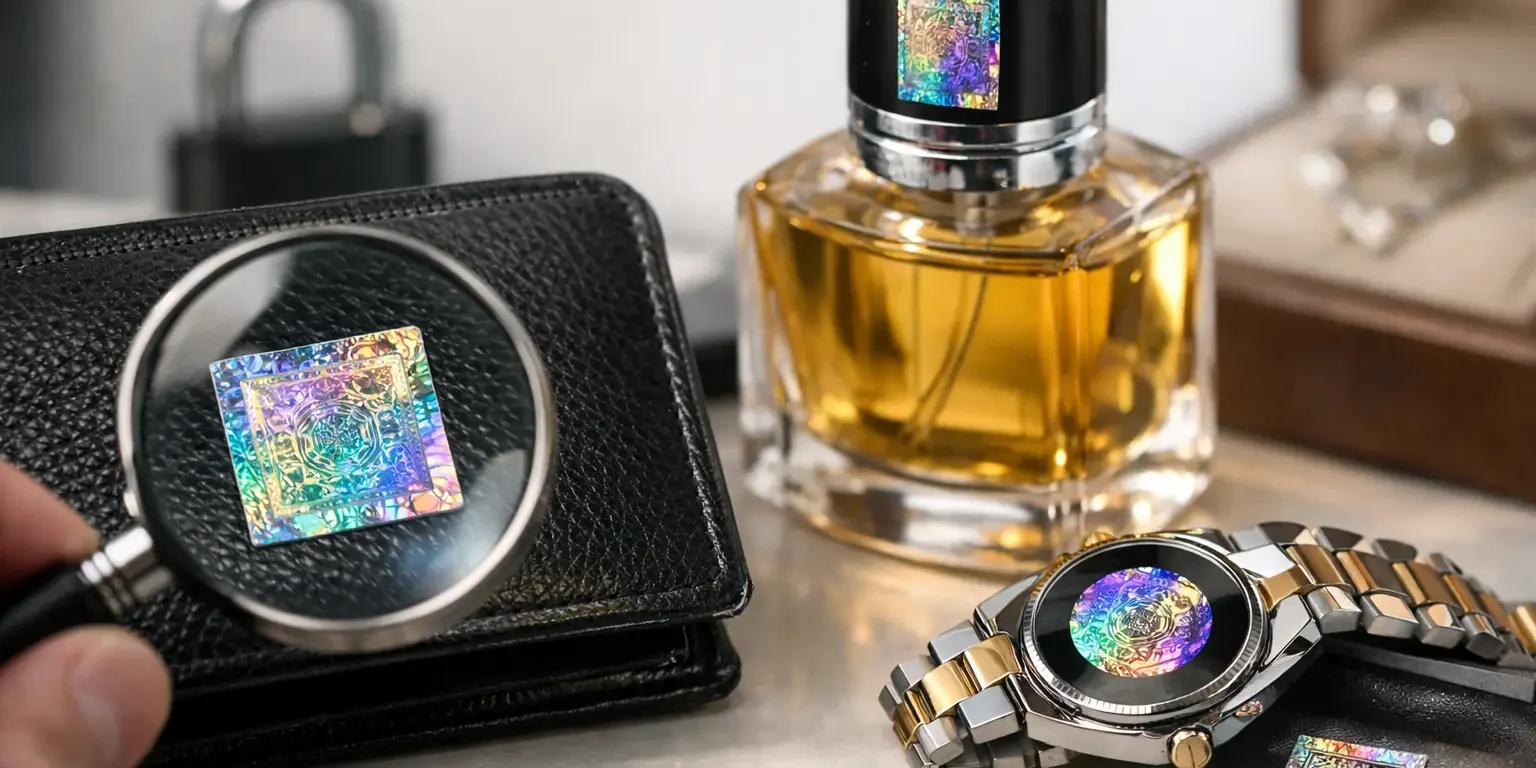
Hologram labels are a familiar choice because their changing visual effect is difficult to reproduce using ordinary printing. They provide an immediate indication that a product belongs to an authorised range and can be produced with bespoke artwork, company names, logos or sequential numbering.
Tamper-evident labels add another layer of control. Depending on the material selected, removal may leave a visible residue, reveal a void message or cause the label to break apart. This makes them useful for warranty seals, access points, cartons, equipment covers and calibration-sensitive components.
Custom printing also has a role. A distinctive layout, precise logo reproduction, variable numbers and controlled use of colour create details that a casual copy is less likely to match accurately. These are not a replacement for specialist security features where the risk is high, but they strengthen the overall label design.
Unique numbering is where accountability begins
Sequential serial numbers are one of the most useful features available because they connect a physical item to an internal record. Each number can be assigned to a batch, product, customer, location or individual asset. If an item is returned, found in the wrong place or questioned by a customer, the number gives your team a starting point.
Barcodes and QR codes speed up that process. A barcode is often the simplest option for organisations using scanners and established inventory software. QR codes can hold more information and can be read by a mobile device, although the code should lead to a controlled verification process rather than a generic webpage.
The code format must suit the equipment and system already in use. There is little value in specifying a barcode symbology that your scanners cannot read or that your asset register cannot accept. Before ordering, confirm the data format, character length, whether check digits are required and the minimum size needed for dependable scanning.
Label materials need to match the application
Authentication fails if the label falls off, fades, curls at the edges or becomes unreadable. Material and adhesive should be selected around the surface, conditions and expected service life, not just the appearance of the finished label.
Polyester labels are commonly selected for durable equipment identification because they offer good resistance to handling and a professional finish. Strong permanent adhesive is suitable for many smooth, clean surfaces, while more demanding applications may need a specialist adhesive for textured plastics, powder-coated metal, low-energy surfaces or exposure to oils and moisture.
For tamper protection, the construction is equally important. A destructible vinyl label behaves differently from a void label, and both should be tested on the actual substrate where possible. Surface contamination, heat, cold and cleaning agents can affect adhesion and the way a seal reacts when removed.
Do not overlook label size. Security features, serial numbers and scannable codes need enough room to remain clear. Reducing a label to fit an awkward location can make a barcode unreliable or leave too little space for meaningful information. A bespoke layout can often solve the problem without compromising function.
Authentication works best as a process, not a print feature
A label can only support the checks behind it. If numbers are issued without a record, or staff have no clear method for responding to a failed check, the label becomes decorative rather than protective.
Start by deciding what a genuine item should be matched against. This may be a stock register, a batch record, an asset management system, a delivery note or a controlled list held by an authorised team. Keep the process proportionate. A low-risk consumable may only require a visible hologram and batch number, while high-value parts may need a serialised label checked at receipt, installation and service.
Define who can approve labels, who receives the serial-number data and how unused or damaged labels are handled. It is sensible to restrict access to label files and number ranges, particularly where the label proves warranty status, product approval or safety compliance.
Staff training does not need to be complicated. Show teams where the label is placed, what features to inspect, how to scan or record the number and what to do if a label is missing or looks altered. A short, consistent instruction is more effective than relying on individual judgement.
Common mistakes to avoid
The most frequent error is treating a security label as a standalone answer to counterfeiting. Authentication is strongest when it is paired with controlled distribution, accurate records and a clear checking routine.
Another mistake is using the same serial number repeatedly. A visible number that is not unique offers very limited traceability. Similarly, a QR code that is never checked provides little protection, regardless of how well it prints.
Poor placement can also undermine a good specification. A label should be visible enough to inspect but positioned where it cannot be removed and reapplied without evidence. On equipment, avoid areas exposed to excessive abrasion, moving parts or labels likely to be covered by routine maintenance markings.
Finally, avoid choosing on unit price alone. A cheaper label that fails in service can create replacement costs, missed audit information and false confidence. The most cost-effective choice is one that performs for the intended life of the item and provides the level of deterrence your application genuinely needs.
Ordering a specification that will work
A manufacturer should be able to work from the practical facts: the item being labelled, the surface material, label dimensions, quantity, artwork, data sequence and security requirement. If you need barcodes or QR codes, provide the data source and confirm whether each label needs unique information.
At Security-Label.co.uk, bespoke labels can combine holograms, tamper-evident materials, company branding, serial numbers and machine-readable codes in one clear format. UK production also helps when a project needs practical advice, sample assessment or a fast turnaround without unnecessary complexity.
Before committing to a large run, check a sample on the real product and ask the people who will scan or inspect it to test the process. A well-chosen authentication label should make genuine products easier to recognise, questionable items easier to isolate and everyday accountability easier to maintain.