
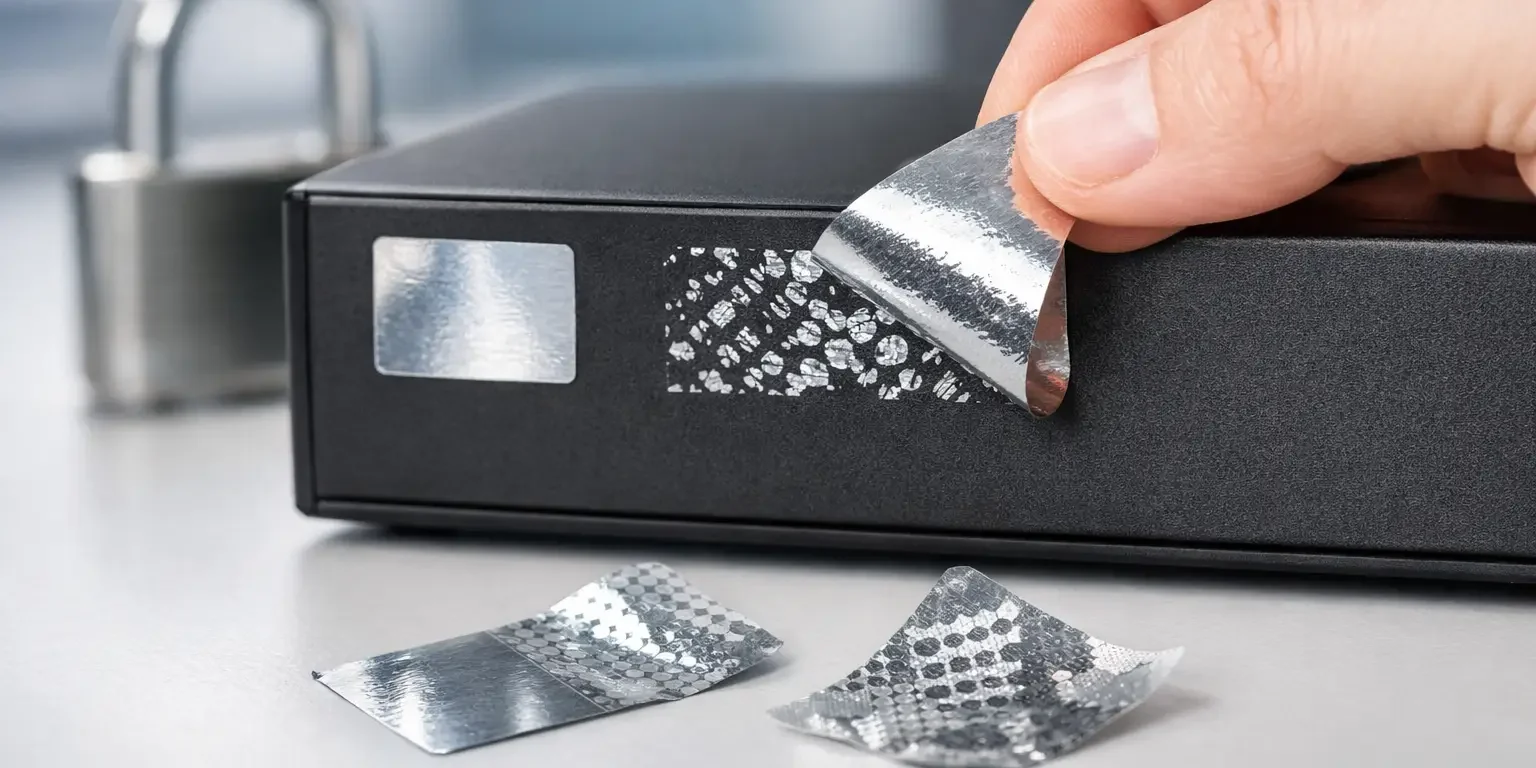
A laptop goes missing, a cabinet has been opened, or a carton arrives with the seal disturbed. In each case, the problem is not just loss – it is uncertainty. Void security labels remove that uncertainty by leaving a clear visual message when someone attempts to peel them away, giving you immediate evidence that an item, package or access point has been interfered with.
For organisations managing valuable equipment, confidential contents or controlled stock, that simple tamper evidence can make day-to-day control much easier. It supports asset accountability, discourages casual interference and gives staff a straightforward way to spot issues quickly. The label does not stop every incident on its own, but it does make tampering much harder to hide.
What are void security labels?
Void security labels are tamper-evident labels designed to show a visible message, pattern or residue when removal is attempted. In many cases, the word VOID appears on the applied surface, on the label itself, or both. Once disturbed, the label cannot normally be repositioned without obvious evidence.
That matters because a standard printed label may peel away cleanly. If that happens, an asset tag, seal or identification label can be transferred, replaced or removed without anyone noticing. A void construction changes that. It provides a built-in warning that the label has been lifted.
This makes void labels a practical choice for equipment housings, cartons, containers, cabinets, medical packs, warranty seals and fixed assets where unauthorised access or label transfer is a concern. They are widely used by schools, NHS departments, local authorities, IT teams, warehouses and private businesses that need a simple but effective tamper-evident measure.
How void security labels work in practice
The performance comes from the label construction rather than the printed design alone. When the adhesive bond is broken, the face material separates in a controlled way so a hidden message or residue becomes visible. That visible change is the security feature.
The exact behaviour depends on the material. Some labels leave a residue on the surface. Others show the message within the label itself. Some are more aggressive and intended for smooth, high-energy surfaces such as metal or rigid plastic. Others are designed for specific applications where removability, lower residue or a cleaner finish is preferred.
This is why surface type matters. A void label that performs well on powder-coated metal may behave differently on textured plastic, cardboard or curved equipment casings. Temperature, cleaning chemicals, moisture and the length of time the label has been applied can also affect results. In other words, choosing the right stock is not just a design decision – it is an application decision.
Where void security labels make the most sense
The most common use is asset protection. If you manage laptops, monitors, test instruments, AV equipment or handheld devices, a void asset label helps deter removal and swap-outs. Once applied, it becomes much harder for a label to be transferred from one item to another without showing evidence.
They are also useful for access control. Cabinets, electrical panels, server racks and storerooms often need a low-cost way to show whether a door or cover has been opened. A void seal label gives a quick visual check without requiring electronic monitoring.
In distribution and storage, these labels can be applied to cartons, cases and totes to indicate whether goods have been opened in transit or while held on site. That can be particularly useful for high-value components, confidential documents or regulated items where chain of custody matters.
Warranty sealing is another common application. If a service panel, enclosure or product casing should not be opened without authorisation, a void label provides a clear record of interference. It sets expectations for the user and gives the supplier visible evidence if the seal has been broken.
Void security labels versus destructible labels
Buyers often compare void labels with destructible vinyl labels, and the right option depends on what you need the label to achieve.
A void label is designed to reveal tampering through a message or residue. A destructible label is designed to break into small pieces when removal is attempted. Both provide tamper evidence, but they do so differently. If your priority is a very clear hidden message such as VOID, that points towards a void construction. If you want the label to fragment aggressively and become almost impossible to remove in one piece, destructible material may be the better fit.
There is also a surface consideration. Some destructible materials perform especially well on smooth permanent applications, while some void constructions offer a better balance where visual evidence is the main requirement. For many asset tracking jobs, either could work. The better choice depends on substrate, expected environment and how obvious you need the tamper evidence to be.
What to consider before ordering void security labels
The first question is what the label is protecting. An IT asset label used for inventory control may need a company name, serial number, barcode or QR code as well as tamper evidence. A carton seal may only need sequential numbering. A warranty seal might need compact sizing and a very aggressive adhesive.
The next point is the application surface. Smooth metal, ABS plastic, textured plastic, coated card and painted surfaces all behave differently. If the wrong adhesive is selected, you risk poor adhesion or inconsistent tamper performance. That is where specialist advice saves time and wasted orders.
Print content matters too. Many organisations want void labels to do more than one job. It is common to combine tamper evidence with asset numbers, barcodes, QR codes, logos or department names. That helps with auditing and inventory management, while also making the label harder to substitute.
Size should be chosen around readability and available space, not guesswork. A small label can work well for warranty sealing, but if it needs a scannable barcode and human-readable serial number, a larger format may be necessary. There is always a balance between security, scan performance and practical placement.
Custom void security labels for asset control
For many organisations, off-the-shelf tamper labels are only half the answer. The stronger option is a custom label that ties the security feature to your internal asset system.
Adding unique serial numbers allows each item to be tracked individually. Barcodes can integrate with handheld scanners and asset management software. QR codes can support mobile scanning where that suits your process better. A company name or logo also acts as a visual deterrent, because the label is clearly assigned to your organisation and difficult to repurpose elsewhere.
This is especially useful for schools, universities, offices and multi-site operations where equipment moves between rooms, departments or buildings. A plain tamper label might show interference, but a bespoke numbered label can also support stock checks, audit trails and ownership identification.
As a specialist manufacturer, Security-Label.co.uk works with customers who need that combination of tamper evidence, print customisation and fast UK supply. In practice, that usually means discussing the surface, label size, numbering format and whether a barcode or QR code is needed before production starts.
Common mistakes with void security labels
One of the biggest mistakes is treating every surface as the same. Labels that work well on one device may not perform identically on another, particularly where there are textured plastics, low-surface-energy materials or heavily curved areas.
Another is overlooking the environment. If equipment is exposed to heat, cleaning fluids, abrasion or outdoor conditions, the material and adhesive need to be selected accordingly. A label intended for indoor office use may not hold up well in a workshop, plant room or delivery environment.
Poor placement is another avoidable issue. If the label is applied across a seam, edge or opening point, it should be positioned so that any tampering clearly affects the label. If it is tucked away where nobody checks it, the security benefit is reduced.
It is also worth remembering that tamper-evident labels are one part of a wider control process. They work best when supported by asset registers, regular checks and clear internal procedures.
Are void security labels right for every job?
Not always. If the surface is heavily textured, contaminated, damp or deliberately low energy, another tamper-evident material may be more suitable. If the item is used in very harsh industrial conditions, the label specification needs careful review. And if the main goal is simple identification rather than tamper evidence, a durable polyester asset label may be enough.
That said, void labels are often the best fit when you need visible evidence of interference without adding complexity or high cost. They are straightforward to apply, easy to inspect and effective across a wide range of assets and sealed items.
If you are responsible for equipment, stock or access points that should not be opened, moved or relabelled without notice, void security labels are a practical place to start. The right specification gives you more than a printed sticker – it gives you a clear signal when something needs attention.