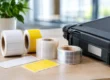

A laptop goes missing from a meeting room, and the asset register says it is still on site. That kind of gap usually starts with a simple problem – labels that are too easy to peel off, swap or remove without a trace. Destructible vinyl security labels are designed to stop exactly that. Instead of lifting away cleanly, they break apart when removal is attempted, leaving obvious evidence that the label has been interfered with.
For organisations that manage IT equipment, tools, devices, stock or regulated assets, that visible tamper evidence matters. It helps deter opportunistic theft, discourages asset relabelling, and gives teams a more reliable way to identify equipment over time. If you need a label that does more than display a number or barcode, destructible vinyl is often the right place to start.
What destructible vinyl security labels actually do
The core function is straightforward. A destructible vinyl label bonds firmly to a surface and is engineered to fragment if someone tries to remove it. That means it cannot usually be transferred intact from one item to another. In practical terms, that makes it much harder for a stolen monitor, printer or handheld device to be passed off as legitimate simply by moving the asset label.
This is where destructible vinyl differs from standard polyester or paper labels. A conventional label may carry the right serial number or barcode, but if it can be peeled away in one piece, it offers limited protection against deliberate misuse. Destructible vinyl adds a layer of control. The label is not just identifying the asset – it is helping secure the integrity of that identification.
That said, no label material is right for every environment. Destructible vinyl is excellent for anti-transfer and tamper indication, but it is not always the best choice for heavily textured, dirty or very low-energy surfaces where adhesion can be more challenging. Material selection still matters.
Where destructible vinyl security labels are most effective
These labels are widely used on assets that are portable, valuable or frequently handled. In offices and schools, that often means laptops, tablets, docking stations, monitors and projectors. In facilities and operations settings, it may include tools, test equipment, radios and control devices. In healthcare and public sector environments, it can help support asset accountability on equipment that moves between rooms or departments.
They are also useful where audit trails matter. Finance teams, procurement departments and asset managers often need a dependable link between the physical item and the asset register. If a label has been broken or partially removed, that is a visible prompt to investigate. It may indicate unauthorised movement, attempted tampering or poor handling.
Another strong use case is warranty and inspection control. A destructible label can be printed with a service code, serial number or inspection reference, making it clear if a unit has been opened or relabelled. For some organisations, that simple visual cue saves time during checks because staff do not have to guess whether a label is original.
Why buyers choose destructible vinyl over standard asset labels
The main advantage is deterrence. People are less likely to tamper with an asset label when they know removal will be obvious. That alone can reduce casual misuse.
The second advantage is traceability. These labels can be printed with sequential numbering, barcodes or QR codes, so they still work as part of a wider asset management system. You are not choosing between security and identification. You can have both in one label format.
The third advantage is cost control. Replacing missing equipment is expensive, but so is the admin that follows disputed ownership, failed audits or missing serial records. A more secure label is a small cost compared with the time and expense of sorting out preventable issues later.
There is, however, a trade-off. Because destructible vinyl is designed to break on removal, it is not suitable if you expect to reposition the label later. If assets are regularly reconditioned, resold or reallocated and need relabelling as part of that process, you should plan for replacement labels rather than trying to reuse the originals.
Destructible vinyl security labels and barcode printing
For many buyers, the label is only useful if it works with existing scanning systems. That is why print quality and layout are just as important as the tamper-evident material. A destructible label can carry a simple asset number, but it can also include Code 128, Code 39, QR codes, Data Matrix codes and company branding, depending on how your equipment is tracked.
The surface area needs to be considered carefully. Small labels may suit compact devices, but the barcode still needs to scan reliably. If too much information is squeezed into a small format, readability suffers. In those cases, it is often better to simplify the data on the face of the label and link it to fuller records in your internal system.
This is where specialist advice makes a difference. The right label is not just about choosing a tamper-evident stock. It is about matching material, adhesive, size and print format to the way your team actually uses the asset.
What to consider before ordering destructible vinyl security labels
Surface type should be your first check. Smooth, clean, flat surfaces generally give the best results. Powder-coated metals, plastics and painted equipment housings are common applications, but testing is sensible if the substrate is rough, curved or exposed to contamination.
Environmental conditions matter too. If the asset is used outdoors, exposed to cleaning chemicals, heat, moisture or frequent abrasion, those factors should be considered from the outset. Destructibility is only one part of performance. The printed information still needs to remain legible.
You should also think about how the labels will be applied. Asset labels perform best when fitted to a clean, dry surface with firm pressure. If staff are applying labels quickly across a large estate, consistency can suffer. A good label specification helps, but a straightforward application process helps just as much.
Customisation is another practical point. Many organisations need logos, department names, contact details, sequential numbering or barcode integration. A bespoke layout often improves adoption because the label fits the existing asset process rather than forcing the process to adapt to a generic label.
When another security label material may be better
Destructible vinyl is a strong option, but not the only one. If you want a label to leave a residue or hidden message such as VOID when removed, a tamper-evident polyester may be more suitable. If long-term outdoor durability is the priority, another film construction may offer better weather resistance. If the goal is simply asset identification at the lowest cost, a standard durable asset label may be enough.
The right answer depends on what risk you are trying to reduce. If your main concern is label transfer between assets, destructible vinyl is usually a good fit. If your concern is evidence that a sealed enclosure has been opened, a different tamper-evident construction may be more appropriate. Buyers often get better results when they define the problem first and the material second.
Getting the specification right the first time
A well-specified label saves money because it avoids replacement orders, failed scans and poor adhesion. In most cases, the key details are size, artwork, numbering sequence, barcode type, adhesive performance and the surface the label will be applied to. If any of those are unclear, it is worth resolving them before print begins.
For UK organisations, lead time and supply reliability are also part of the decision. A fast turnaround is useful, but consistency matters more when labels are tied to audits, rollouts or new equipment deployments. Working with a specialist manufacturer such as Security-Label.co.uk can make this easier because the conversation starts with the application, not just the price list.
That practical approach is often what separates a label that looks fine on screen from one that performs properly in service. Security labels are rarely bought for appearance alone. They are bought to reduce risk, improve control and support day-to-day accountability.
Destructible vinyl security labels do that well when they are matched to the job properly. If you need a label that cannot be removed and reapplied without obvious damage, they are one of the most effective and affordable options available. The best place to start is with the asset itself – where it is used, how it is tracked, and what would happen if its identity could be changed without anyone noticing.