
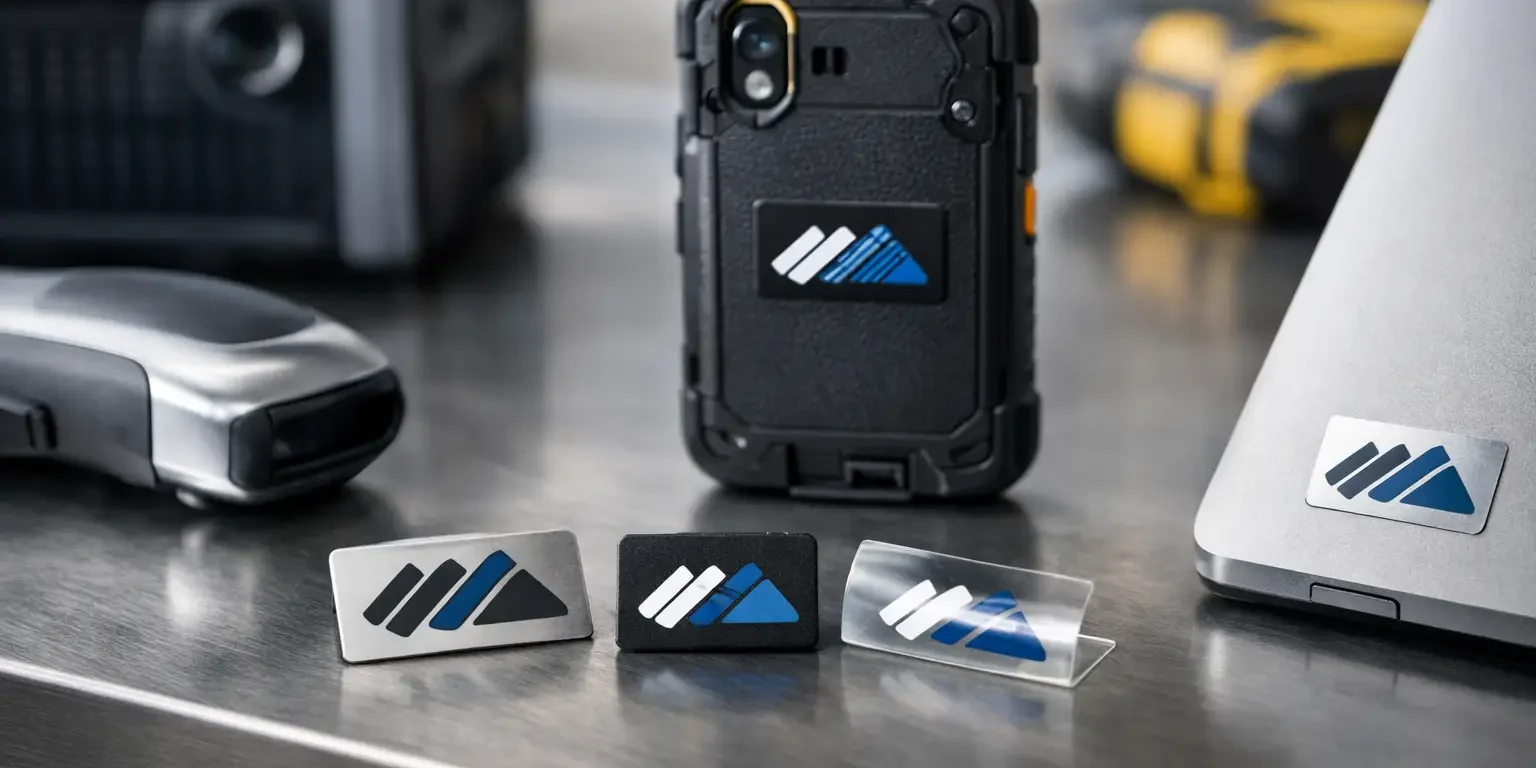
A missing laptop rarely starts as a major problem. It starts as a small admin gap – a faded label, no serial scan, a logo missing from the asset ID, or equipment moved between sites without a clear record. Custom asset labels with logo help close that gap. They make ownership obvious, support faster checks, and give teams a practical way to identify, track and recover equipment across everyday operations.
For many organisations, the logo matters just as much as the asset number. It immediately shows that an item belongs to your business, school, charity or public body. That visibility can deter casual theft, reduce mix-ups between departments, and make it easier for staff, contractors and auditors to confirm who owns what. The label becomes part of your control process, not just a sticker.
Why custom asset labels with logo work better
Standard off-the-shelf labels can mark an item, but they often stop short of what organisations actually need. A generic numbered label may identify one device from another, yet it does little for brand recognition, accountability or integration with your internal system. Once you add a company logo, a barcode, a QR code or a structured serial format, the label becomes more useful across purchasing, finance, IT and facilities.
That matters in real working environments. An IT manager may need to scan equipment during a rollout. A school business manager may want a quick way to identify tablets assigned to a classroom. A facilities team may need to check tools, testing equipment or handheld devices across several buildings. In each case, the label needs to stay legible, adhere properly and match the way the asset register is organised.
A logo also adds a visible ownership cue that plain numeric labels do not. If equipment leaves a building, is sent for repair, or is found in the wrong department, a branded label gives an immediate point of reference. It is simple, but effective.
What to include on custom asset labels with logo
The right layout depends on how you manage your assets. Some buyers need a clean label with a logo and sequential numbering. Others need barcodes, QR codes, department names or contact details. There is no single correct format, but there are some practical choices worth getting right at the start.
Most organisations begin with a company logo and a unique asset ID. That could be a simple numeric sequence or a more structured reference that reflects location, department or asset type. If your team scans items during stock checks, a barcode or QR code is usually worth adding. It cuts manual entry, reduces errors and speeds up routine audits.
The label size also matters. A desktop PC, server, monitor or plant item can usually take a larger label with more data. A tablet, charger, handset or medical device may need a smaller format with tighter spacing. Cramming too much information onto a small label often creates problems later, particularly if the barcode becomes difficult to scan or the text is too small for quick visual checks.
It is also worth thinking about permanence. Some buyers want labels that resist wear but can still be removed with effort. Others need tamper-evident materials that show clear signs of interference. The right answer depends on the asset value, the environment and the level of security required.
Choosing materials for real working conditions
A label that looks good on screen is not enough. Asset labels have to cope with heat, cleaning products, daily handling, textured surfaces and years of general wear. Material choice is where specialist input makes a real difference.
Polyester is a common option for durable asset identification because it offers good resistance to abrasion, moisture and routine handling. For many office, education and commercial settings, it gives a reliable balance of performance and cost. If assets are exposed to harsher environments, stronger adhesives or more specialised constructions may be needed.
Surface type is one of the biggest factors. Smooth metal and coated plastics are generally straightforward. Powder-coated equipment, low-energy plastics and uneven surfaces can be more demanding. If the adhesive is wrong, even a well-printed label will fail early. That is why it helps to match the label stock to the asset, rather than assuming one material suits everything.
Tamper-evident options are worth considering where theft deterrence or unauthorised transfer is a concern. Destructible vinyl, void materials and other security constructions can show that a label has been removed or interfered with. They are not necessary for every application, but for laptops, AV equipment, tools, test instruments and other mobile assets, they can add a useful extra layer of control.
Barcodes, QR codes and serial numbers
A good asset label should fit the way your team works. If your process relies on scanning, the barcode format needs to be chosen properly. A poorly selected barcode can create avoidable issues with print size, readability or system compatibility.
Code 128 is often suitable where compact, high-density numbering is needed. QR codes can be useful if you want to store more information or direct staff to an internal record or support process. Sequential serial numbering remains a strong option for simple visual control and can be combined with either barcode type.
The practical point is this: the code should serve your process, not complicate it. If staff are only doing manual checks once a year, a large clear serial may matter more than a dense barcode. If assets move regularly between users or sites, scanning may save enough time to justify a more structured format.
Design choices that affect long-term performance
There is a tendency to focus on appearance first, especially when adding a logo. Branding matters, but clarity matters more. A label should be easy to read at a glance and easy to scan when needed.
High contrast is usually best. Black text on a silver, white or yellow background tends to perform well in practical settings. Very dark branded backgrounds or low-contrast print can reduce readability. If your logo includes multiple colours, it may need simplifying for small-format print.
Font size is another common issue. Tiny text may look neat on artwork approval, but it is less useful when someone is standing in a storeroom, checking assets against a list. Where possible, prioritise the asset number, company name and scan element. Secondary details can be added, but not at the expense of core usability.
When bespoke labels are worth it
Not every organisation needs a fully bespoke product. If your requirements are straightforward, a standard size with a logo and sequential numbers may do the job well. But bespoke labels become worthwhile when your assets, systems or compliance needs are more specific.
That could mean matching a particular barcode symbology, fitting labels to unusual equipment sizes, adding tamper evidence, or using a stronger adhesive for difficult surfaces. It may also mean splitting number ranges by department, including site references, or producing multiple designs for different asset categories.
This is where a specialist manufacturer offers more value than a general printer. Asset identification is a technical product category. The print quality matters, but so do the material, adhesive, numbering logic and intended use. Getting those details right upfront usually saves time, relabelling costs and operational frustration later.
What buyers should ask before ordering
A few practical questions can prevent most ordering mistakes. Start with where the labels will be applied and how long they need to last. Then consider whether the labels will be scanned, whether tamper evidence is required, and how much data needs to fit on each one.
You should also check who will apply the labels. A warehouse team labelling hundreds of items may prefer a format that is quick to peel and position. A small office ordering labels for periodic use may have different priorities. Quantity matters too. Short runs are useful for pilot projects or smaller organisations, while larger batches usually offer better unit value.
For UK buyers, lead time and supply consistency are often just as important as price. Fast turnaround can be critical when onboarding equipment, replacing worn labels or preparing for an audit. Working with a specialist UK manufacturer such as Security-Label.co.uk can make that process more straightforward, particularly when you need advice on materials or barcode setup rather than just print.
The real value is control
Custom asset labels with logo are not a cosmetic extra. Done properly, they support accountability, reduce avoidable loss and make routine asset management easier for the people who actually have to do it. The best labels are the ones that still scan, still adhere and still make sense months or years after they are applied.
If you are reviewing your asset control process, it is worth treating labels as part of the system rather than an afterthought. A clear logo, durable material and sensible data layout can do more than identify an item – they can make the whole process easier to trust.