
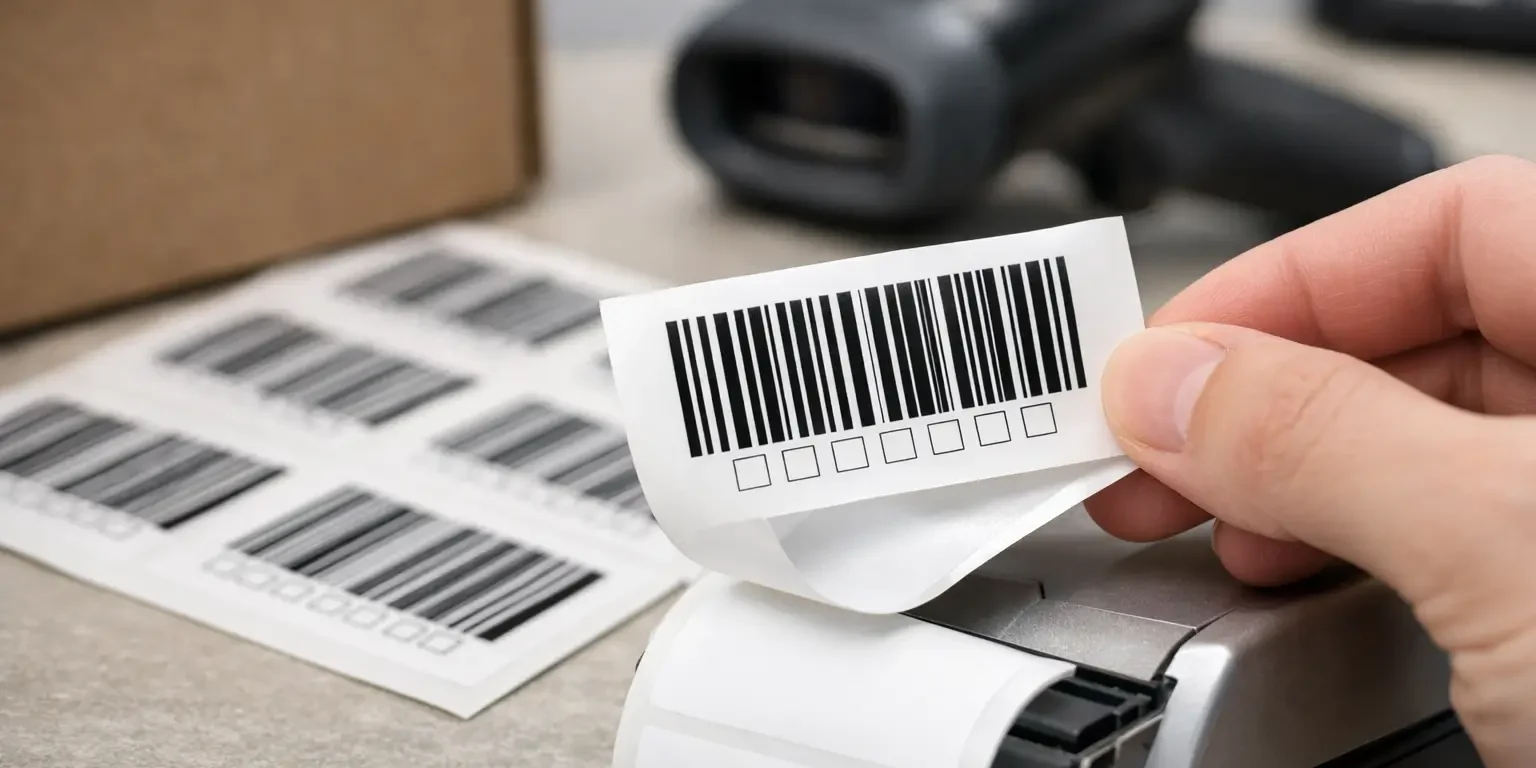
A missing laptop during an audit usually exposes the same problem: the item exists on a spreadsheet, but no one can identify it quickly on site. Barcode labels with serial numbers solve that gap by giving every asset its own scannable identity and a human-readable reference at the same time. For schools, offices, depots, hospitals and public sector estates, that simple combination makes stock control faster, asset registers cleaner and accountability much easier to enforce.
The value is practical rather than complicated. A barcode can be scanned into your system in seconds, while the serial number gives staff a visible fallback if the label is worn, the scanner is unavailable or the asset needs to be checked manually. When both elements are printed together, you reduce data entry errors and make it easier for different teams to work from the same record.
Why barcode labels with serial numbers work so well
Asset identification only works when labels are easy to use in real conditions. That means they need to scan reliably, stay attached and remain legible over time. Barcode labels with serial numbers are effective because they cover both machine reading and human reading without asking staff to change how they work.
In practice, this matters most where assets move between rooms, sites or users. IT equipment, tools, test devices, tablets, AV equipment and maintenance stock are all vulnerable to poor record keeping if identification depends on handwriting or generic labels. A serialised barcode label gives each item a unique identity, so you are not just marking a type of equipment – you are marking that exact unit.
That distinction supports more than stock checks. It helps with insurance records, internal investigations, maintenance history, warranty tracking and replacement planning. If a department says a device has gone missing, you can trace a specific serial number rather than trying to work out which of six identical units was last seen.
Where serialised barcode labels are most useful
Most organisations do not need every label to be sophisticated, but they do need consistency. The strongest use case is fixed asset management, where each item in your register needs a unique identifier that can be matched to finance, facilities or IT records.
Schools and academies often use serialised labels on laptops, tablets, projectors and classroom equipment. Facilities teams use them on plant, tools and maintenance assets. Offices rely on them for deskside hardware, monitors and phones. In healthcare and laboratory settings, they help track devices that must be checked, serviced or assigned to specific users.
They are also valuable for inventory control, though the requirement can differ. If you are labelling product lines for stock movement, a repeating barcode may be enough. If you need traceability by individual item, issue record or service history, unique serial numbers become much more useful.
Choosing the right barcode format
Not every barcode is suitable for every job. The correct format depends on what your software expects, how much data you need to encode and how the labels will be scanned.
Code 128 is a common choice for asset labels because it is compact, versatile and works well for alphanumeric data. Code 39 is also widely used and can suit systems that prefer a simpler, established format, though it generally takes up more space. If the label needs to carry more information in a smaller area, a QR code may be the better option, especially when staff use mobile devices rather than dedicated scanners.
This is one of the main areas where specialist advice saves time. A barcode that looks acceptable on screen can perform badly once reduced to a small label, laminated, printed on a textured surface or scanned under warehouse lighting. The right answer depends on the label size, the print quality required and the scanning environment.
Barcode labels with serial numbers: material matters
The print design is only half the decision. The material needs to match the surface, environment and expected lifespan of the asset. This is where many low-cost off-the-shelf labels fail.
For indoor office equipment, a durable polyester label is often the sensible choice. It gives a professional finish, resists general wear and holds print clearly. For rougher conditions, stronger adhesives and more resistant constructions are usually needed. Labels applied to metal cabinets, workshop tools or cleaning equipment may face abrasion, moisture, temperature changes or regular handling.
Tamper-evident materials are worth considering where theft deterrence or unauthorised transfer is a concern. If someone tries to remove the label, the face material can destruct or leave a visible residue pattern. That does not physically stop theft, but it makes relabelling and concealment much harder. For organisations with frequent asset movement, that extra layer of control can be valuable.
There is a trade-off, though. Ultra-destruct materials are not always ideal on delicate surfaces, heavily textured finishes or assets that may need legitimate relabelling later. A dependable supplier will usually ask what the labels are going onto, how long they need to last and whether tamper evidence is a requirement rather than an assumption.
What to include on the label
A good asset label should be clear at a glance. Overloading it with too much information often makes scanning worse and legibility poorer. In most cases, the essentials are the barcode, the serial number and the organisation name or logo.
Some buyers also include wording such as Property of, Asset No., or a helpdesk reference. Others add a QR code for mobile scanning or a warning that the label is tamper-evident. The best layout depends on label size and how staff will use it day to day. If the serial number is too small to read easily, the backup value is lost. If the barcode is too dense, scan reliability can suffer.
This is why bespoke layout matters. A label should fit the asset and the working process, not force your process to fit a generic template.
Common ordering mistakes and how to avoid them
The most common mistake is treating label selection as a print job rather than an identification system. Buyers often focus on dimensions and price first, then discover later that the barcode format is wrong, the adhesive fails on powder-coated surfaces or the numbering sequence does not match their register.
Another issue is ordering labels without thinking about application conditions. A label applied in a cold store, on a dusty tool chest or onto curved equipment housing may need a different construction from one used on a clean office monitor. Surface energy, contamination and handling all affect performance.
Data preparation can also cause delays. If you need consecutive numbering, linked barcode values or a combination of prefixes and serial sequences, the data file needs to be set up accurately. A simple numbering plan at the start prevents duplicate references and confusion later.
For that reason, many organisations benefit from a short conversation before ordering. It is far cheaper to confirm the material, barcode symbology and numbering structure upfront than to replace labels that looked fine in a proof but fail in service.
When standard labels are enough, and when bespoke is better
Standard barcode labels can work perfectly well for straightforward indoor asset marking. If you need a common size, basic consecutive numbering and a conventional barcode for office equipment, a standard specification may do the job well and keep costs down.
Bespoke labels become more valuable when you have specific operational demands. That could mean matching a fixed asset register format, adding branding, using a tamper-evident construction, fitting an awkward application area or producing labels that must survive tougher environments. Public sector buyers, IT departments and facilities teams often find that a tailored label reduces hassle later, even if the initial specification takes a little longer.
A specialist manufacturer such as Security-Label.co.uk can usually add value here because the discussion is not just about print. It is about scan performance, durability, numbering logic and how the label behaves once it is actually in use.
Getting better results from your asset labelling system
The label itself is only part of the outcome. To get the full benefit, your numbering system should be consistent, your asset records should be current and staff should know where labels belong on each item. A good placement rule helps scanning and extends label life. Flat, visible and low-wear areas are normally best.
It also helps to think ahead. If your estate is growing, leave room in the numbering structure for future departments, sites or asset classes. If mobile phones are now scanned with camera apps, consider whether QR codes should sit alongside conventional barcodes. If theft or unauthorised swapping is a concern, review whether a tamper-evident option is justified.
Well-made barcode labels with serial numbers do not just identify assets. They support cleaner audits, faster stock checks and better control over equipment that costs real money to replace. When the label is designed properly, applied to the right surface and matched to your system, it becomes one of the simplest ways to reduce administrative friction across the whole organisation.
If you are ordering labels for an asset register, it is worth being clear on three things before you start: what needs to be scanned, what needs to be read by eye and what the label must survive once it leaves the box.