
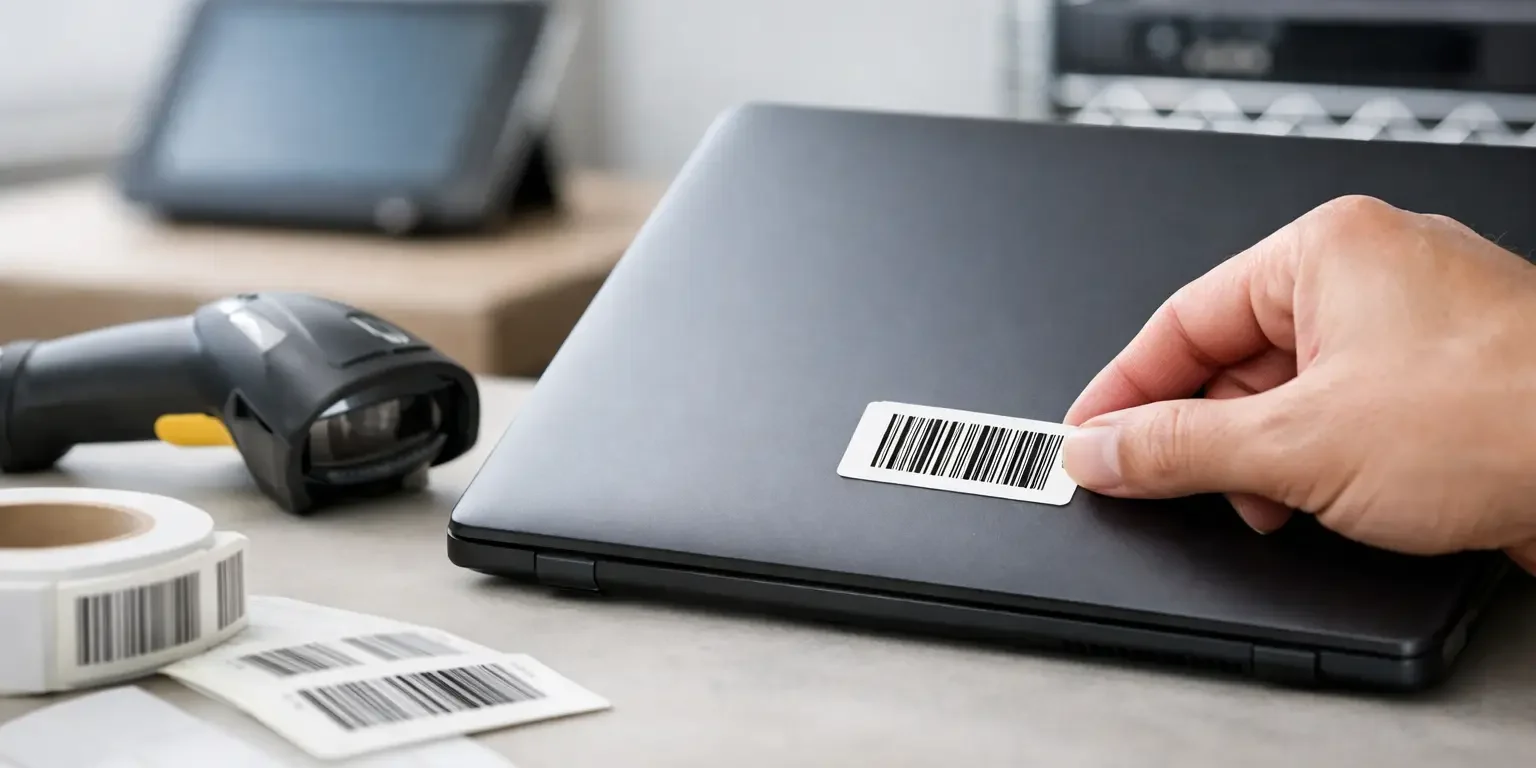
An asset register only works if people can identify the item in front of them quickly and without doubt. That is why asset labels with barcodes are more than a print detail. They give finance, IT, facilities and operations teams a practical way to tag equipment, scan it accurately and keep records aligned with what is actually on site.
For many organisations, the problem is not whether to use asset labels. It is choosing labels that stay readable, stay attached and suit the way assets are checked. A desktop computer in a school office, a laptop moved between departments and a piece of plant equipment in a warehouse do not need exactly the same label specification. The right choice depends on the surface, the environment, the expected lifespan and whether you also need theft deterrence or tamper evidence.
Why asset labels with barcodes make day-to-day control easier
A printed asset number can work, but scanning is faster and far less prone to error. When staff manually enter serial numbers, small mistakes are common. A missed digit or transposed character can create confusion in the asset register, especially when similar devices are held in volume.
Barcode labels reduce that friction. A quick scan during audits, maintenance checks or room moves helps teams confirm what item they are handling and update records straight away. That matters in schools, NHS settings, councils, offices and warehouses where equipment is shared, relocated or temporarily assigned.
There is also an accountability benefit. Once every item has a unique asset ID and barcode, it becomes easier to record issue dates, locations, users and service history. If something goes missing, the label supports a clearer paper trail. If an auditor asks for proof of control, the system is easier to demonstrate.
What to include on asset labels with barcodes
The most effective label designs are usually straightforward. In most cases, buyers want a company name or logo, a unique asset number and a barcode that matches that number. Some also add a QR code, department name, phone number or wording such as Property of or Do Not Remove.
The best layout depends on how the label will be used. If staff mainly scan assets during stock checks, the barcode needs to be large enough for reliable reading and printed with good contrast. If the label is also there as a visual deterrent, the asset number should remain clear at a glance. Trying to cram too much information into a very small size often creates more problems than it solves.
Sequential numbering is a common requirement because it supports simple asset registration and avoids duplication. For organisations already using internal reference formats, it usually makes sense to mirror that structure on the label so the printed ID matches the database exactly.
Material choice matters more than many buyers expect
A barcode is only useful if it stays legible. This is where material selection becomes important.
Polyester is a common choice for durable asset labels because it offers good resistance to wear, cleaning and handling. It suits many indoor applications, including IT equipment, office furniture, tools and classroom devices. For buyers who need a professional, long-lasting finish, it is often the practical starting point.
Vinyl can be useful where greater flexibility is needed, particularly on curved or uneven surfaces. Paper labels may be acceptable for short-term internal use, but for fixed asset identification they are usually a false economy. They scuff more easily, absorb moisture and tend to look tired long before the asset reaches end of life.
Adhesive choice matters too. A label fitted to powder-coated metal, textured plastic or low-energy surfaces may need a different adhesive from one applied to a smooth office monitor. If labels peel at the corners after a few months, even a perfectly printed barcode becomes a liability.
When tamper-evident labels are the better option
Not every asset needs tamper evidence, but some certainly do. If equipment is portable, high value or vulnerable to unauthorised swapping, a standard barcode label may not be enough on its own.
Tamper-evident constructions make interference visible. That can mean a destructible label that fragments when removal is attempted, or a material that leaves behind a void message. In both cases, the point is simple: if someone tries to remove or transfer the label, there is clear evidence.
This is particularly useful for laptops, tablets, test equipment, AV devices and assets held in public-facing or shared environments. It acts as a deterrent, but it also supports investigations when labels have clearly been disturbed. There is a trade-off, though. Tamper-evident materials are designed for security rather than repositioning, so they need to be applied carefully and to the right surface first time.
Choosing the right barcode format
The barcode itself should fit the scanning system already in use. This is one area where specialist advice can save time, because not all formats behave the same way.
Code 128 is widely used for asset tracking because it is compact and can encode letters and numbers efficiently. Code 39 is also common and works well in many systems, though it usually takes up more space for the same data. If your software provider specifies a particular symbology, it is usually best to follow that requirement rather than guess.
For smaller labels or where more data needs to be stored, a QR code may be worth considering. That said, QR codes are not automatically better. If your handheld scanners and software are set up for linear barcodes, introducing QR codes without checking compatibility can create unnecessary hassle. The sensible approach is to match the printed code to the way your team actually works.
Common buying mistakes and how to avoid them
One of the most common mistakes is choosing the smallest label possible. Buyers often want to keep labels discreet, but if the barcode is too small or the text too compressed, scanning becomes unreliable. A label should fit the asset, but it still needs enough space for clean print and easy reading.
Another issue is underestimating the environment. Labels used in clean offices face very different conditions from those exposed to moisture, abrasion, heat or regular cleaning. A low-cost option can look attractive on paper, yet fail early when put into daily use.
Artwork can also cause problems. Tiny logos, reversed-out text and poor contrast may look fine on screen but print poorly at label size. A dependable manufacturer will usually guide buyers towards a layout that works in practice, not just one that looks tidy in a proof.
Finally, some organisations order labels without fully thinking through their numbering structure. If departments use different formats, or if old and new sequences overlap, future audits become harder than they need to be. A little planning at the ordering stage often prevents a lot of administrative tidying later.
What UK buyers should check before ordering
The simplest way to get the right label is to define how and where it will be used. Start with the asset type, then think about the surface, expected lifespan and whether the item stays put or moves around the organisation. From there, decide whether the label is purely for identification or also for deterrence and tamper evidence.
It also helps to confirm your barcode requirements in advance. Check which barcode symbology your system accepts, whether you need sequential numbering and if scanners will be used at close range or from a distance. These details affect size, layout and print quality.
For many buyers, lead time matters just as much as specification. If an audit is due, a site move is approaching or new equipment is being rolled out, delays create knock-on problems. Working with a specialist UK manufacturer can make a real difference here, especially when you need practical advice rather than generic print supply. Security-Label.co.uk focuses specifically on asset and security labels, which means buyers can get guidance on materials, barcodes and tamper options without wading through unrelated products.
Price still matters, of course, but value is about more than unit cost. A cheaper label that fails early, scans badly or peels from equipment is likely to cost more in replacement time and asset confusion. For most organisations, the better decision is the label that stays in place, stays readable and supports the system already in use.
If you are ordering asset labels for the first time or reviewing an existing specification, treat the label as part of your control process rather than an afterthought. A well-made barcode label does a quiet but important job every day – and when audits, stock checks or loss investigations come around, that quiet job becomes very visible.