
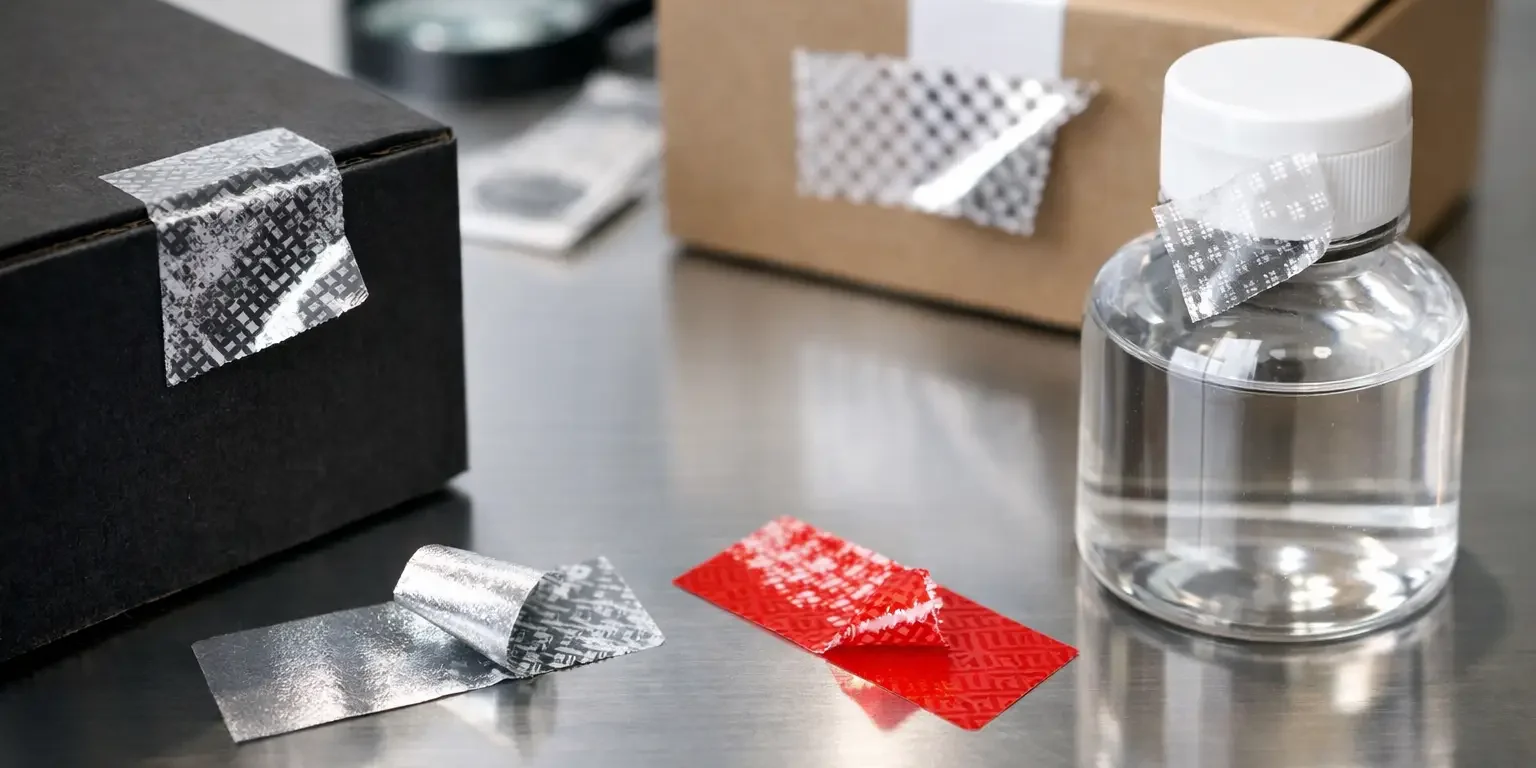
A missing laptop charger is annoying. A missing hard drive, test instrument or sealed cabinet key is a different problem entirely. That is where tamper-evident security labels earn their place. They do more than mark an item – they show whether someone has tried to remove, open or interfere with it, which gives your team a clear visual warning before a minor issue turns into an audit, loss or compliance headache.
For organisations managing equipment across offices, schools, depots, clinics or shared workspaces, the right label is rarely just a sticker. It needs to stay put, remain legible, and react in a predictable way when tampering occurs. If it fails on adhesion, print clarity or durability, the whole purpose is undermined.
What tamper-evident security labels actually do
Tamper-evident security labels are designed to leave evidence behind when removal is attempted. Depending on the construction, that evidence may appear as a destructible break-up pattern, a residue message such as VOID, or a clear sign that the label face has been compromised. The point is not to make removal impossible in every case. The point is to make interference visible, immediate and difficult to conceal.
That distinction matters. A standard identification label helps you track an asset. A tamper-evident label adds a layer of control. It supports internal accountability, deters opportunistic theft, and helps teams spot unauthorised access to equipment, cases, cabinets and sealed packaging.
In practice, these labels are often used on IT equipment, calibration devices, medical equipment, leased assets, electrical items, tool stores and any item that should not be opened, swapped or quietly removed from service without authorisation.
Where tamper-evident security labels work best
The best applications are the ones where visual evidence is genuinely useful to the people doing the checking. That could be an IT manager inspecting returned laptops, a facilities team checking extinguisher cabinets, or a school administrator verifying tagged equipment before a room move.
They are especially effective when paired with asset data. A label carrying a company name, sequential serial number, barcode or QR code does two jobs at once. It identifies the item and signals if the label has been disturbed. That makes stock checks quicker and gives finance, operations and audit teams a cleaner trail to follow.
There is a trade-off, though. If your main requirement is long-term outdoor exposure or extreme abrasion resistance, some tamper-evident constructions may not be the best fit on their own. In those cases, material choice becomes more important than the headline feature of tamper evidence.
How to choose tamper-evident security labels
The right specification depends on what you are labelling, where it is used, and what sort of tampering you need to reveal. A label applied to a desktop PC in a temperature-controlled office has a very different job from one used on a warehouse scanner, metal enclosure or reusable transit case.
Start with the surface
Surface type affects almost everything. Smooth powder-coated metal, textured plastic, low-energy plastic and painted finishes all behave differently. A label that performs well on one surface may struggle on another, particularly if there is texture, contamination or regular cleaning.
For high-value assets, it is worth checking not only whether the label sticks, but how it fails when removal is attempted. A destructible vinyl may fragment effectively on a smooth casing but behave less predictably on heavily textured surfaces. A residue label may provide better evidence on one substrate and less on another. Testing against the actual asset is usually the sensible route.
Think about the environment
Heat, cold, moisture, cleaning chemicals and abrasion all influence lifespan. If labels are going onto equipment handled daily, wiped down often, or stored in harsher conditions, print method and laminate choices matter just as much as adhesive choice.
This is where buyers can get caught out by cheap generic options. A low-cost security label might look fine when first applied, then fade, lift at the corners or become unreadable within months. If the barcode will not scan during an audit or the serial number cannot be read, you lose part of the value.
Decide what evidence you need
Not all tamper evidence works in the same way. Some labels break apart on removal. Others leave a hidden or visible residue message. Some are better for permanent asset marking, while others suit sealing applications where opening itself is the event you need to record.
It depends on the risk. If the concern is that a label may be transferred from one asset to another, a stronger tamper response is sensible. If the requirement is to show that a panel, lid or carton has been opened, a seal-style construction may be more appropriate.
Print matters as much as material
A surprising number of label problems have little to do with the face stock and everything to do with the information printed on it. If the text is too small, the numbering sequence is inconsistent, or the barcode format does not suit your system, the label creates friction instead of control.
For asset management, clear human-readable numbering is still essential even when barcodes or QR codes are added. People need to identify items quickly without always reaching for a scanner. At the same time, the barcode needs to be produced at the right size and resolution for the scanning equipment you already use.
There is no single best format for every organisation. Code 128, Code 39 and QR codes each have advantages depending on data length, scanner compatibility and workflow. A specialist manufacturer should help you match the print layout to the way your team actually records and checks assets.
Common buying mistakes
One of the most common mistakes is choosing on price alone. Cost matters, especially for larger rollouts, but replacing failed labels, re-tagging assets and correcting register errors is rarely cheap. A slightly better specification at the start often saves time and money later.
Another mistake is overlooking application conditions. Labels applied to dusty, cold or damp surfaces will not perform as intended, even if the material itself is suitable. Basic preparation matters. Clean, dry application onto the right area of the asset usually makes a noticeable difference to long-term adhesion.
Buyers also sometimes ask for every feature at once – tamper evident, outdoor durable, ultra-small, highly detailed, aggressively adhesive and easy to remove. Some combinations are realistic; some involve compromise. Good advice at quotation stage helps avoid ordering a label that is technically impressive but poorly suited to the job.
When bespoke labels are worth it
Off-the-shelf labels can work for simple needs, but bespoke tamper-evident security labels are often the better choice when accountability and presentation matter. Adding your logo, serial numbers, departmental wording or barcode structure makes labels easier to integrate into existing asset registers and internal controls.
Custom sizing is also useful. A label should fit the asset cleanly without wrapping around curved edges, covering vents or sitting on textured joins. Small details like that affect both adhesion and readability.
For schools, councils, NHS suppliers, contractors and growing businesses, bespoke labels also support consistency across departments and sites. When everyone is using the same numbering logic and layout, checking equipment becomes simpler and disputes are easier to resolve.
Why UK manufacture can make a practical difference
Security labels are not usually something buyers want to overcomplicate. They want a quick answer, sensible pricing, and confidence that the product will do the job. That is where dealing with a specialist UK manufacturer can help.
Shorter lead times, easier communication and the ability to discuss materials with someone who understands tamper-evident applications all reduce procurement risk. For customers who need a fast repeat order, custom numbering, or advice on whether a label should be destructible or residue based, that direct support is often more useful than a long catalogue with minimal guidance.
For that reason, many organisations prefer working with specialists such as Security-Label.co.uk rather than treating security labels as a generic print purchase.
A practical way to make the right choice
If you are specifying labels for the first time, start with three questions. What asset or opening needs protection, what environment will the label face, and what should happen if somebody tries to remove it? Those answers usually narrow the choice quickly.
From there, focus on a label that balances tamper evidence, adhesion, print clarity and day-to-day usability. The right product is not the one with the longest feature list. It is the one that makes checks easier, discourages interference and stays readable for as long as you need it.
A well-chosen security label will not solve every asset control problem on its own. What it will do is give your team a clear, visible signal when something is not as it should be, and that is often exactly what keeps a small issue from becoming a larger one.