A serial number printed on a label used to be enough to deter casual theft. It is no longer enough on its own. The future of anti counterfeit labels is moving towards security that is harder to copy, easier to check and more useful to the organisation managing the item.
For UK businesses, schools, councils and facilities teams, this is not only a product-authenticity issue. Counterfeit asset labels can hide stolen equipment, create gaps in audit trails and make it harder to establish ownership after a loss. The most effective labels will continue to combine visible deterrence with reliable identification and practical records.
Why ordinary labels are easier to defeat
Standard printed labels can be reproduced with readily available equipment. Even a barcode or QR code is not automatically secure if it simply contains a fixed number that can be copied from one item to another. A convincing duplicate may pass a visual check while providing no proof that the label was originally issued for that asset.
This does not mean every organisation needs a highly complex security programme. The right level of protection depends on the value of the item, how easily it can be moved or resold, and the consequences if it goes missing. A desktop monitor in a controlled office needs a different solution from medical equipment, IT hardware used across multiple sites, or branded goods moving through a supply chain.
The direction of travel is clear: labels must do more than display information. They need to help staff recognise genuine items, show when interference has occurred and support a credible asset record.
The future of anti counterfeit labels is layered security
The strongest approach is rarely a single feature. It is a combination of features that makes copying or removing a label unattractive and easier to detect. One feature may be visible to anyone handling an item; another may be checked by trained staff; a third may connect the label to a controlled database or asset register.
Visible features will remain valuable
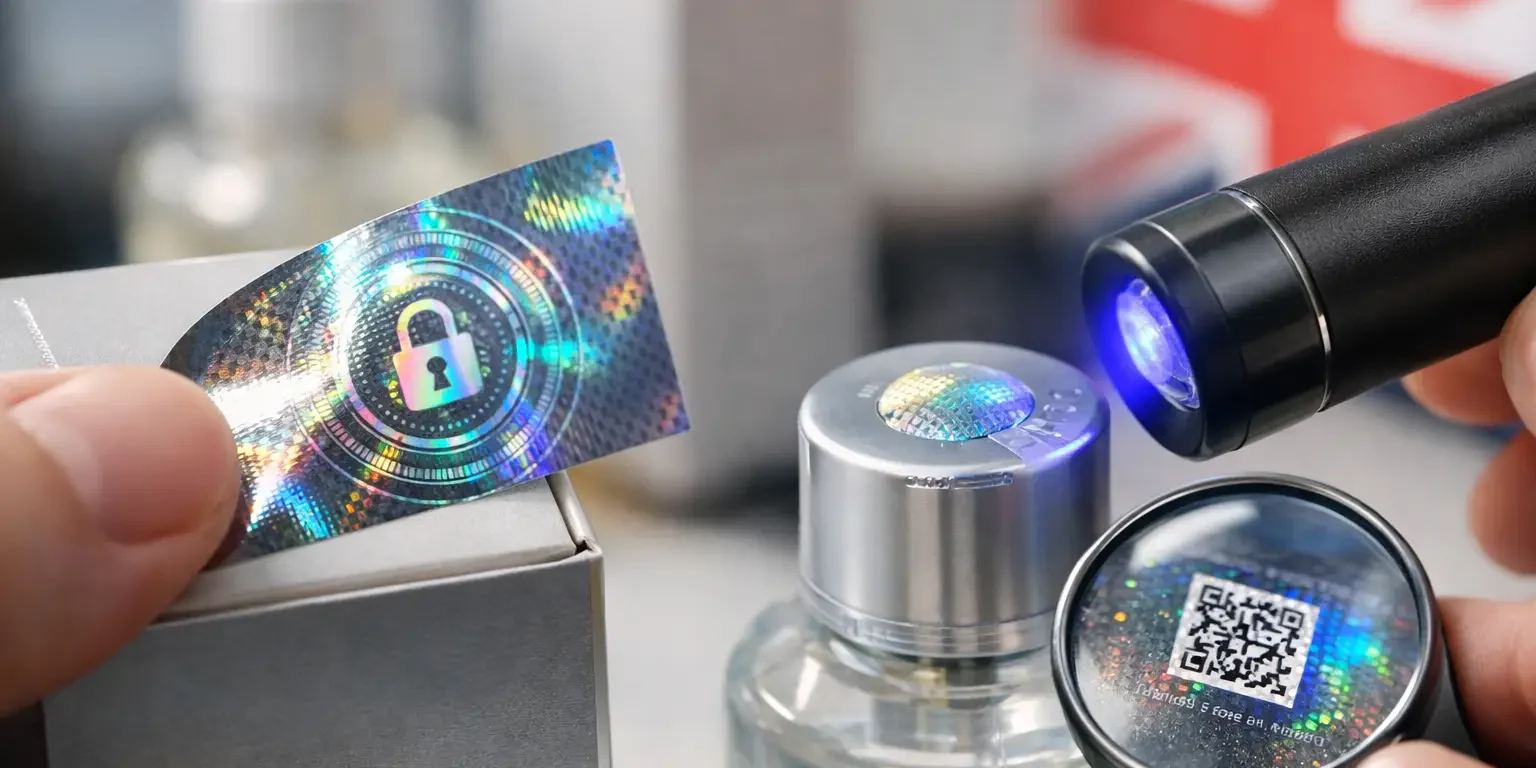
Holographic effects, colour shifts, fine-detail printing and bespoke company designs remain useful because they create an immediate visual barrier. A genuine hologram label is difficult to reproduce faithfully with general office printing, particularly where it includes a custom design, serial numbering or other personalised detail.
Visible security is also practical. A receptionist, technician or warehouse operative can make a first check without specialist equipment. For organisations managing large volumes of lower-value assets, this may be the most proportionate level of deterrence.
However, visible features should not be treated as proof by themselves. Counterfeiters can imitate the general appearance of a label. The future lies in pairing visual signals with information that can be verified.
Unique identities will matter more than generic codes
Every protected item should have its own unique identifier. This may be a sequential serial number, a barcode, a QR code, or a combination of these. The identifier must be recorded against an asset description, location, owner or department in the organisation’s own system.
The key point is that a code should lead to a meaningful check. If two laptops carry the same supposedly unique number, staff need a process that flags the duplication. If a QR code is scanned, it should support a verification step rather than merely opening a generic webpage.
For many organisations, a barcode remains the most efficient choice for regular stocktakes and asset movements. QR codes are useful where staff need to retrieve more information using a mobile device, such as handling instructions, service history or a report-loss process. The best format depends on the scanner, software and working environment already in use.
Tamper evidence will become part of authentication
Authentication asks whether a label is genuine. Tamper evidence asks whether it has been removed, opened or interfered with. These needs overlap, especially for assets that may be stolen and relabelled.
Destructible vinyl labels, checkerboard residue labels and labels that void on removal make transfer far more obvious. Once lifted, they either break apart or leave a permanent message on the asset surface. A thief may still remove the label, but they cannot do so cleanly, and the item carries evidence of interference.
This is particularly useful for laptops, tools, audiovisual equipment, laboratory devices and other equipment that can be moved between rooms or sites. It also gives facilities and IT teams a quick visual prompt to investigate an item before it is redeployed or disposed of.
There is a trade-off. Highly aggressive adhesives and residue systems must be selected carefully for delicate finishes, textured surfaces or equipment that is intended for resale. Testing a sample on the actual substrate is sensible before committing to a large order.
Material performance will be a security issue
A security label that fades, curls or detaches in normal use creates its own vulnerability. Future anti-counterfeit solutions will place as much emphasis on durability as on clever visual effects.
Polyester labels are a dependable choice for many indoor fixed-asset applications because they resist handling, moisture and general wear. Laminated options provide extra protection where labels are cleaned frequently or exposed to more demanding conditions. For outdoor plant, industrial equipment or challenging surfaces, material, adhesive and print method must be specified for the environment rather than chosen on price alone.
Poor adhesion is often caused by surface contamination, low surface-energy plastics, rough paint finishes or labels applied in cold conditions. A specialist manufacturer should ask where the label will be used, what it will adhere to and whether tamper evidence is required. This reduces the risk of ordering an attractive label that fails before it has done its job.
Verification must work in real operations
The most sophisticated label has little value if the people using it cannot verify it quickly. Future systems need to fit the reality of busy stores, workshops, offices and public-sector estates.
A practical process may be as straightforward as scanning an asset barcode during annual stocktaking, checking the serial number against a register when equipment is returned, and training staff to report a voided or damaged label. Higher-risk applications may justify controlled database checks, restricted access to serial-number ranges, or additional covert features known only to authorised personnel.
The important decision is not whether a technology sounds advanced. It is whether it reduces loss, improves accountability and can be used consistently. A simple, well-run serialised label system will usually outperform an expensive solution that no one has time to maintain.
Data protection and continuity need planning
Connected labels can create useful records, but organisations should avoid placing sensitive data directly in a visible code. An asset number is usually appropriate. Personal names, detailed equipment configurations or internal security information may not be.
It is also worth planning for what happens when software changes, a department is reorganised or a supplier relationship ends. Labels should retain enough visible information to identify the asset even if a database is temporarily unavailable. A company name, contact detail, asset number and tamper-evident feature can still provide a strong foundation.
For long-life equipment, consistency matters. Use a numbering structure that can expand, document the chosen barcode symbology, and retain records of serial-number batches. These straightforward controls make it easier to investigate duplicate labels and maintain an accurate register over several years.
Choosing the right level of protection
A useful starting point is to classify equipment by risk. Consider replacement cost, portability, resale value, safety implications and how often the item changes hands. Then match the label specification to the result.
For routine office assets, a durable personalised polyester label with a unique serial number and scannable barcode may be sufficient. For portable IT equipment, a tamper-evident construction and a clear ownership message add a worthwhile layer. For high-value, regulated or frequently counterfeited goods, custom holographic features, controlled serialisation and a formal verification process may be justified.
Security-Label.co.uk produces bespoke labels in the UK with options for serial numbers, barcodes, QR codes, holograms and tamper-evident materials. The practical value of bespoke production is not simply adding a logo. It is specifying a label that suits the asset, the surface, the checking process and the level of risk.
The future will not belong to one anti-counterfeit technology. It will belong to labels that are difficult to copy, inconvenient to remove and simple for legitimate staff to verify – backed by records that make every asset accountable.