
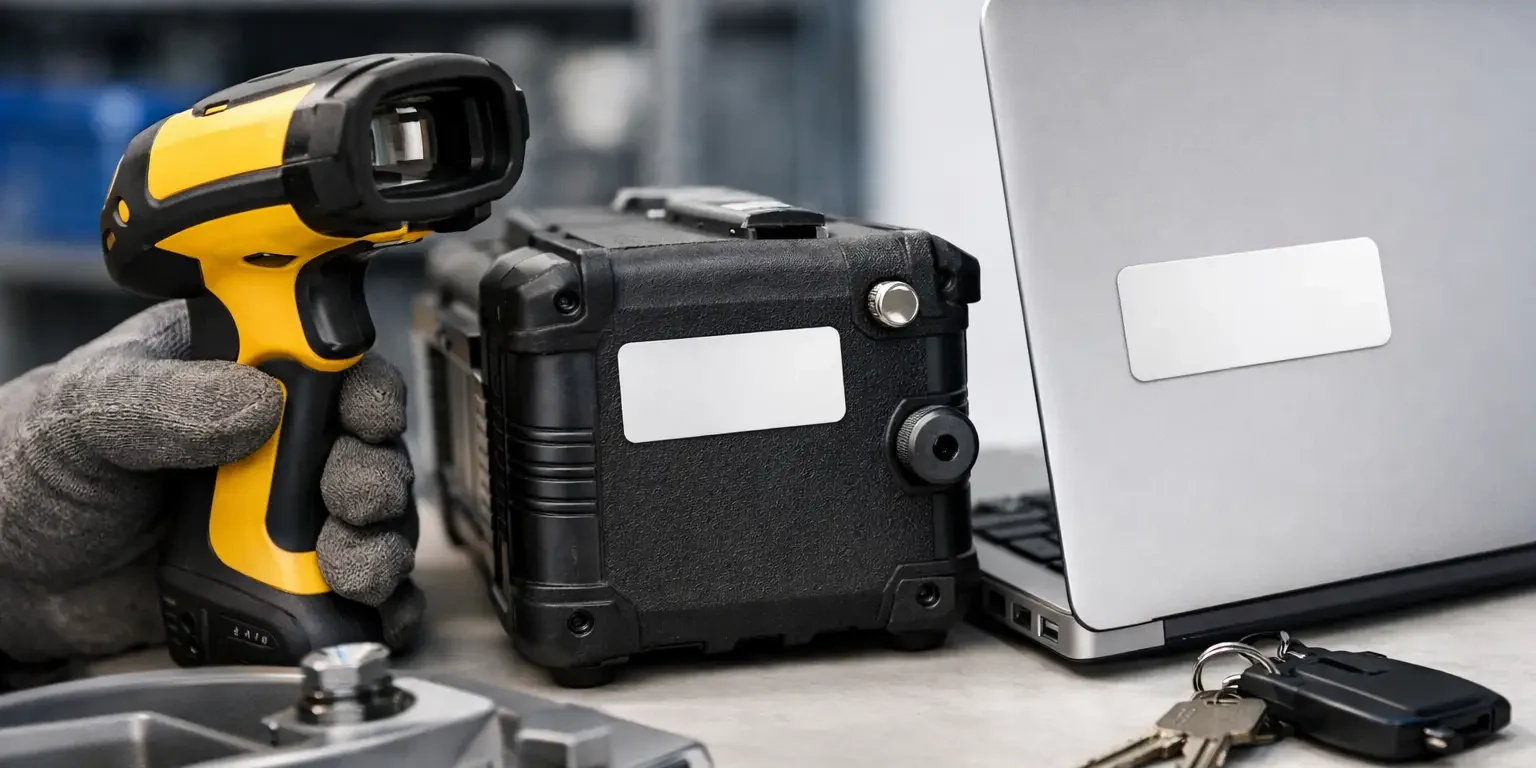
A missing laptop, an untraceable power tool or equipment returned without its asset number can quickly become an audit problem. Polyester vinyl labels give organisations a practical way to identify equipment clearly, connect it to an asset register and make removal or substitution more difficult.
The material matters as much as the printed information. A label that curls, fades or lifts after a few months leaves an organisation back where it started. For IT equipment, school resources, facilities assets and operational machinery, the right specification should remain readable for the working life expected of the item.
What are polyester vinyl labels?
The phrase polyester vinyl labels is often used broadly to describe durable plastic asset labels. In practice, polyester and vinyl are different material families, and they have different strengths. It is worth confirming the actual face material before ordering, particularly where labels will face heat, cleaning chemicals, textured surfaces or attempted removal.
Polyester, often referred to as PET, is a stable, hard-wearing film widely used for asset identification. It provides a professional finish, good dimensional stability and reliable print quality for small text, serial numbers and machine-readable barcodes. It is well suited to laptops, monitors, printers, electrical equipment, instruments, cabinets and many indoor fixed assets.
Vinyl is generally more flexible. This makes it useful where the label needs to follow a curve, conform to an uneven surface or cope with movement. It can be a sensible choice for certain outdoor items, containers, tools and equipment with shaped housings. The exact performance still depends on the adhesive, thickness, print process and protective laminate.
Neither material is automatically better. Polyester is usually the stronger choice for crisp, long-life equipment labels on smooth surfaces. Vinyl may be preferable where flexibility and conformability are the priority. The important point is to match the label construction to the asset and its environment rather than buying on material name alone.
When polyester labels are the right choice
A standard paper label may be adequate for short-term stock control, but it is rarely suitable for assets that are handled, cleaned, moved or retained for several years. Polyester labels are commonly specified when organisations need a durable, consistent identification mark that supports day-to-day tracking.
They work particularly well for assets with smooth, non-porous surfaces, such as painted metal, coated equipment panels and hard plastic casings. A polyester asset label can carry a company name, logo, asset number, serial number, barcode or QR code without becoming difficult to scan or read.
This is especially useful for organisations maintaining an asset register. The label becomes the physical reference point between the equipment in front of the user and the record held in finance, IT service management or inventory software. A clear serialised label reduces transcription errors and makes stock checks quicker.
For schools, local authorities and multi-site businesses, a consistent label layout also helps staff recognise ownership immediately. That visible identification can discourage casual theft and makes equipment easier to return when it has been misplaced or transferred between departments.
Print durability needs to match the environment
A durable film alone does not guarantee a durable label. The printed image must withstand normal handling, abrasion and cleaning. For equipment that will be wiped regularly, exposed to oils or used in workshops, ask about suitable print protection and finishing.
Small barcodes need particular care. A barcode that scans perfectly when new can fail if it is printed too small, placed over a textured area or exposed to repeated abrasion. Allow enough clear space around the code, choose an appropriate barcode size and test it with the scanners your team actually uses.
QR codes are useful where staff scan with mobile devices and need to access more information than a short barcode can hold. However, they should not replace a visible asset number entirely. A human-readable reference remains valuable when a scanner is unavailable or the code is damaged.
Adhesive is often the deciding factor
The best printed label is of little value if it does not stay in place. Adhesive selection should be based on the surface condition, not simply the material of the equipment.
Smooth, clean surfaces generally allow a permanent adhesive to form a strong bond. Textured plastic, powder-coated metal, low-energy plastics and surfaces that are regularly exposed to dirt or moisture are more demanding. In these cases, a standard adhesive may lift at the edges even when the label itself appears suitable.
Before applying labels, clean away dust, grease, polish and residue, then allow the surface to dry fully. Apply firm, even pressure across the whole label, paying attention to corners. Adhesives normally build strength over time, so labels should not be tested for removal immediately after application.
Temperature also affects results. Applying labels in a cold warehouse or to equipment brought in from outdoors can reduce initial adhesion. If the asset will operate in unusual temperatures, humid conditions or outdoors, state this at the quoting stage. A specialist manufacturer can recommend a more appropriate construction before production begins.
Polyester vinyl labels and tamper evidence
An ordinary durable label identifies an asset, but it does not necessarily show that someone has tried to remove it. Where theft deterrence, warranty control or unauthorised access is a concern, tamper-evident labels provide an additional layer of protection.
A destructible label breaks into fragments when removal is attempted, making it difficult to transfer intact to another item. Void labels leave a visible message or pattern on the surface and, in some cases, on the label itself. These options are useful for laptops, mobile devices, tools, IT hardware, sealed enclosures and equipment where proof of interference matters.
There is a trade-off. Tamper-evident constructions are designed to make removal obvious, so they may not be appropriate for assets that need to be regularly refurbished, resold or relabelled. Surface compatibility also needs checking, particularly on delicate finishes. A sample application is sensible for high-value equipment or unfamiliar surfaces.
For many organisations, the practical answer is a durable polyester asset label for routine identification combined with tamper-evident seals on access panels, sensitive components or items most at risk of unauthorised removal.
Information to include on an asset label
The best layout is not the one containing the most information. It is the one that lets staff identify and scan an item quickly. Most asset labels need an organisation name or logo, a unique asset number and a barcode or QR code linked to the internal register.
Additional information may include a telephone number, return instruction, department name, equipment category or a warning such as “Property of”. Serial numbering can be printed as a simple sequence or matched to existing reference numbers. If the organisation already uses a barcode system, provide the required symbology and data format rather than asking staff to re-key information later.
Common barcode choices include Code 128 for general asset identification and QR codes for mobile phone-based scanning. The right choice depends on the software, scanners and workflow already in use. A barcode should support the process, not force a new one.
Size and placement affect usability
Very small labels can look neat but may compromise barcode scanning and readable text. Conversely, an oversized label can be unsuitable for compact IT equipment or instruments. Choose a size that allows the asset number to be read at a glance and the code to scan reliably.
Place labels where they are visible during stock checks but unlikely to be rubbed constantly by hands, cables, cases or mounting brackets. Avoid ventilation slots, seams, removable covers and heavily curved edges. For laptops and portable devices, a flat, accessible area on the underside is usually more practical than a frequently handled lid.
Ordering durable labels with fewer surprises
A clear specification speeds up production and prevents unsuitable materials being selected. Before requesting a quote, establish the label dimensions, quantity, surface type, indoor or outdoor use, required artwork and whether numbering, barcodes or QR codes are needed.
It also helps to state whether labels must resist attempted removal, cleaning, moisture, heat or abrasion. If there is doubt, provide a photo of the asset surface and explain how it is used. That information is often more useful than a generic request for “permanent labels”.
Security-Label.co.uk produces custom asset and security labels in the UK, including serialised, barcode and tamper-evident options. Low minimum orders can make it practical to trial a specification before committing to a larger estate-wide roll-out.
A label is a small part of an asset management process, but it has a direct effect on whether that process works under pressure. Choose a material, adhesive and print format that suit the equipment in service, and your next audit should involve less searching and more certainty.