
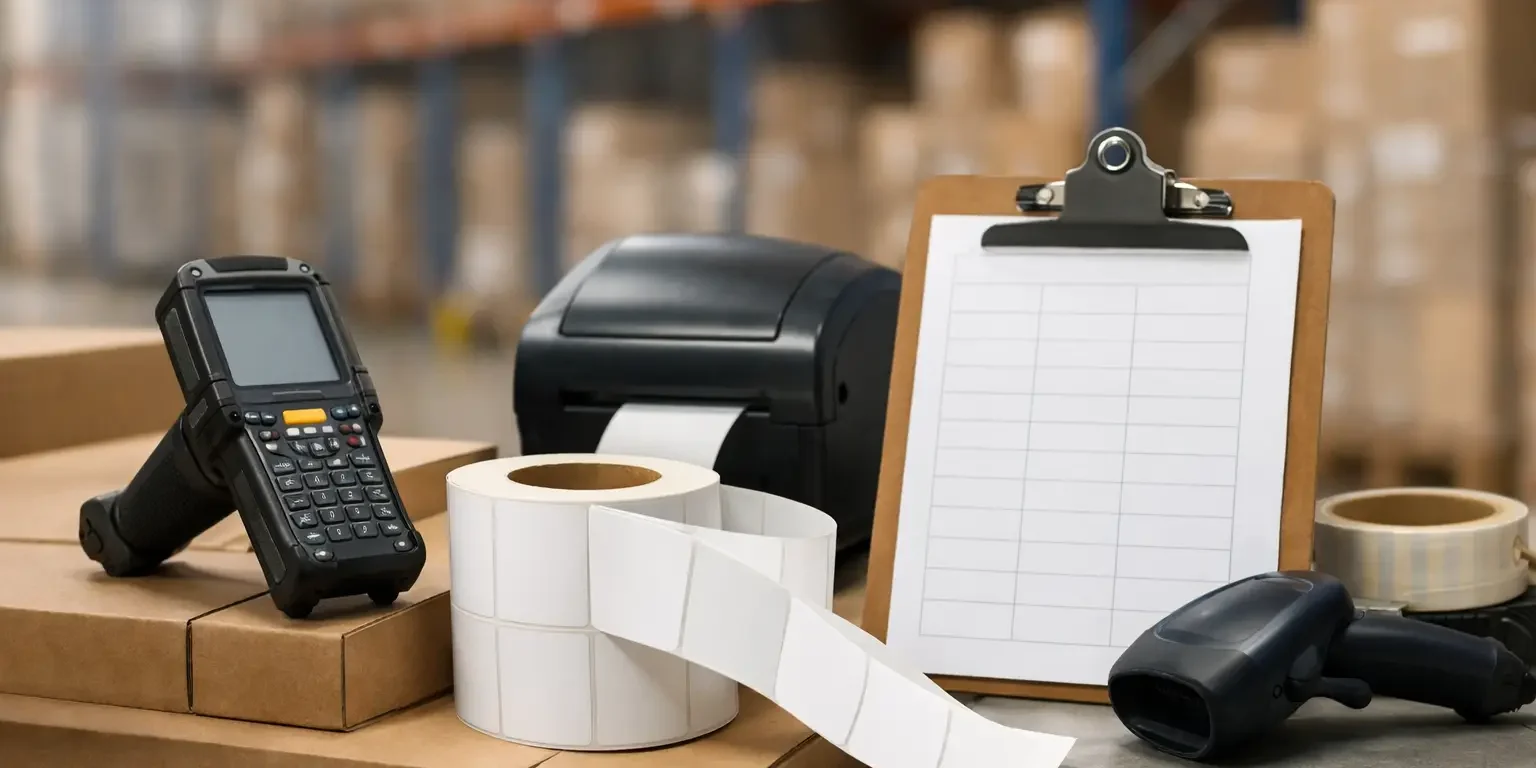
A warehouse label that curls at the corners, cannot be scanned from a picking aisle or disappears after a few months creates more work than it saves. The best labels for warehouse inventory are not simply the cheapest stickers available. They must suit the item or location being identified, the warehouse environment and the way your team records stock.
For most organisations, a reliable solution combines clear human-readable information with a barcode or QR code, printed on a material and adhesive that will remain in place. The right specification improves picking accuracy, supports stock checks and gives managers a more dependable audit trail.
Best labels for warehouse inventory control
There is no single label type that works equally well on every shelf, tote, pallet and piece of handling equipment. A busy ambient warehouse needs something different from a cold store, a manufacturing site or an IT stockroom. Start by separating permanent location identification from labels that move with the stock.
Shelf, bay and racking labels usually need large, easy-to-scan codes that can be read at a practical working distance. Bin and tote labels need to survive repeated handling, cleaning and contact with other containers. Pallet labels may be temporary, but they still need enough print quality and adhesive strength to remain legible throughout storage and distribution. Equipment labels for forklifts, scanners and other fixed assets should be more durable and, where loss or interference is a concern, may also need tamper evidence.
The best choice is therefore based on the operational job the label must do, rather than its appearance alone.
Identify the item, location and level of permanence
A sensible warehouse labelling plan gives every place and item a clear identity. Location labels might follow a format such as warehouse, aisle, bay, level and position. This makes it easier for a new operative to understand where stock belongs, while the barcode provides the machine-readable version for your warehouse management system.
For moving stock, the label should identify the product, batch, stock keeping unit, pallet or container as required. Avoid placing too much information in a small area. A clear product description, a unique reference and a scannable code are often more useful than a crowded label with every detail from the system.
Permanent labels work best for racking, cabinets, machinery and reusable bins. Temporary labels are appropriate for short-life cartons, dispatch units and one-off pallet movements. Mixing these uses can cause problems. A low-cost paper label may be perfectly suitable for a despatch carton, but it is unlikely to last on a frequently cleaned plastic tote or a powder-coated rack upright.
Choose materials for the environment, not just the budget
Paper labels remain a cost-effective option for dry, short-term applications. They are common for carton identification, pick faces with limited wear and labels printed on demand. Their limitation is durability: moisture, abrasion, cleaning fluids and rough handling can quickly make them unreadable.
For longer-term warehouse identification, synthetic materials are normally the better investment. Polyester labels are widely used where strong print definition, abrasion resistance and a professional finish are needed. They are particularly suitable for asset identification, shelving, equipment and indoor locations that receive regular handling. Polypropylene and vinyl options can also suit certain applications, depending on the surface, flexibility required and expected life of the label.
The adhesive matters as much as the face material. Smooth painted metal, bare metal, plastic crates, cardboard and textured racking do not all behave in the same way. Dust, oil, cold temperatures and uneven surfaces can reduce adhesion. If labels are being applied in a chilled area, onto low-energy plastics or onto surfaces that are regularly wiped down, specify this at the outset. Testing a sample on the actual surface is a practical safeguard before committing to a large order.
Make barcodes easy to scan
A barcode is only useful if it scans first time. In a warehouse, poor scan performance slows picking and encourages staff to enter data manually, which is where avoidable errors begin. The barcode format should match your software, scanners and the amount of data you need to hold.
Code 128 is a common choice for internal warehouse references because it is compact and handles letters, numbers and symbols. Code 39 remains useful where older systems require it, although it generally needs more space. QR codes can hold more information and can be read by many mobile devices, making them useful for asset records, inspection instructions or digital documentation. They are not automatically the best choice for every shelf location if a simple 1D barcode already works well with existing handheld scanners.
Print size, contrast and placement are critical. Black bars on a white background provide reliable contrast, while a clear margin around the code helps scanners distinguish it from surrounding text and graphics. Very small barcodes may look tidy but can become difficult to read after minor damage or when scanned at an angle. For rack labels, consider the normal scanning distance and whether operators scan from floor level, a mobile platform or a forklift cab.
Human-readable text should sit alongside the barcode. If a scanner battery fails or a label is partly damaged, staff still need to identify the location or item without guesswork.
Use tamper-evident labels where control matters
Not every inventory label needs a security feature. Adding tamper evidence to routine, low-value consumable stock can add unnecessary cost. It is more appropriate for high-value equipment, controlled stock, sealed containers, restricted cabinets or items that should not be moved without authorisation.
Tamper-evident labels reveal interference when someone attempts to remove them. Depending on the material, they may leave a visible message on the surface, break apart on removal or show that a seal has been opened. This creates an immediate visual check for unauthorised access and makes it harder to transfer an identification label from one item to another.
For organisations tracking IT equipment, specialist tools, test instruments or high-value spares, a durable asset label with a unique serial number and barcode can provide both identification and deterrence. A carefully designed label can also include your company name, an asset reference and contact details for recovered property.
Pre-printed, sequential or on-demand labels?
The right production method depends on how often inventory information changes. Pre-printed labels are ideal for fixed locations, branded asset labels and standard messages. They offer consistent print quality and are particularly useful where barcodes must remain readable for years.
Sequentially numbered labels are useful when each tote, asset, seal or storage position needs a unique reference. The numbers can be combined with corresponding barcodes or QR codes, allowing your team to scan the same identifier that appears in the asset register or stock system.
On-demand thermal labels provide flexibility for changing stock, batches and despatch information. Thermal transfer printing generally offers better durability than direct thermal printing, which can fade with heat, sunlight or prolonged storage. Many warehouses use both: professionally produced durable labels for locations and assets, plus thermal labels for variable stock movements.
Set a clear label standard before ordering
A consistent specification prevents a warehouse from becoming a mixture of different sizes, formats and codes that staff have to interpret. Agree the label size, text layout, barcode standard, numbering structure, material and adhesive for each use. Include a sensible position for application, such as the front edge of a shelf beam or a flat, clean area on a reusable container.
Before rollout, trial a small batch in normal conditions. Ask staff to scan labels during picking, goods-in and stocktaking. Check whether they remain readable after handling and cleaning, and whether the placement avoids knocks from pallets or equipment. This small amount of testing can prevent the cost of replacing hundreds of labels later.
A specialist manufacturer such as Security-Label.co.uk can advise on bespoke layouts, serial numbering, barcode formats and tamper-evident materials, particularly when a standard off-the-shelf label does not match the site conditions. UK production also helps when you need practical advice and a quick turnaround rather than a generic product.
The right warehouse labels make stock control less dependent on memory and workarounds. Specify them around the reality of your operation, test them where they will be used and give every scan a clear, durable starting point.