Counterfeit goods, copied equipment labels and substituted parts create more than a financial problem. They can undermine warranty claims, disrupt maintenance records, expose an organisation to safety risks and make it difficult to prove ownership. The best anti-counterfeit label features make copying harder, checking quicker and tampering immediately visible.
For most UK organisations, the right answer is not the label with the most security devices. It is the label that matches the value of the item, the way staff verify it and the environment it must survive. A laptop fleet, a controlled cabinet seal and branded consumer packaging each need a different level of protection.
What makes an anti-counterfeit label effective?
An anti-counterfeit label should do three jobs. First, it should deter casual copying or removal. Second, it should give staff, customers or inspectors a practical way to identify a genuine item. Third, it should create an audit trail where accountability matters.
A printed logo alone is rarely enough. A determined copier can reproduce standard artwork, especially when the original is photographed or scanned. Security comes from combining visible details, unique data, specialised materials and a sensible verification process.
The most effective approach is layered. A visible feature such as a holographic image may deter opportunistic fraud, while a unique serial number gives each label an identity. Tamper-evident construction then prevents a label being moved from a genuine item to a counterfeit one. The appropriate balance depends on risk, budget and how often the labels will be checked.
Best anti-counterfeit label features for UK organisations
Unique serial numbers
Serialisation is one of the most useful and cost-effective features available. Every label carries a different number, allowing an item to be recorded against an asset register, invoice, service record or warranty claim.
For IT equipment, tools, school devices and fixed assets, sequential serial numbers are usually straightforward to manage. Where counterfeit products are the concern, non-sequential or randomly generated numbers can make prediction more difficult. The key point is that numbers only add real security when they are recorded and checked. A unique number that nobody validates is primarily a visual deterrent.
Serial numbers can be printed in readable text, encoded in a barcode or QR code, or supplied in both forms. Including both gives staff a quick manual fallback if a scanner is unavailable or the code is damaged.
Barcodes and QR codes for verification
Barcode labels speed up stocktaking and improve accuracy in asset management. A Code 128 barcode is commonly used where the label needs to hold an asset number or alphanumeric reference. QR codes can hold more information and can be scanned by a mobile device, which may suit field teams and distributed sites.
For anti-counterfeit use, the code should point to or contain a unique identifier rather than generic product information. A static QR code printed identically on every unit can be copied just as easily as ordinary text. A unique code, checked against your own records, provides a far more useful control.
There is a trade-off. A code can improve verification, but it needs a clear process behind it. Decide who can check it, what they should see when it is scanned and how suspected duplicates will be handled. For some organisations, a simple serial number matched to an internal spreadsheet is sufficient. Others may require integration with an asset management system or product database.
Tamper-evident materials
Tamper evidence is essential when labels are used to show whether a seal has been disturbed, an item has been opened or an asset label has been removed. The right material leaves evidence behind when someone tries to lift it.
Destructible vinyl breaks into small pieces on removal, making the label difficult to remove intact. Void labels leave behind a patterned message, often reading VOID or OPENED, on the surface and sometimes on the label itself. These are particularly suitable for electronic equipment, enclosures, access panels and packaging where removal must be obvious.
Neither option is universal. Destructible labels are highly effective on smooth, clean surfaces but may not suit heavily textured equipment. Void labels are more appropriate where a clear removal message is needed, although the adhesive and face material must be chosen for the surface involved. Testing a sample on the actual item is worthwhile, especially for curved, powder-coated, oily or outdoor surfaces.
Holographic security features
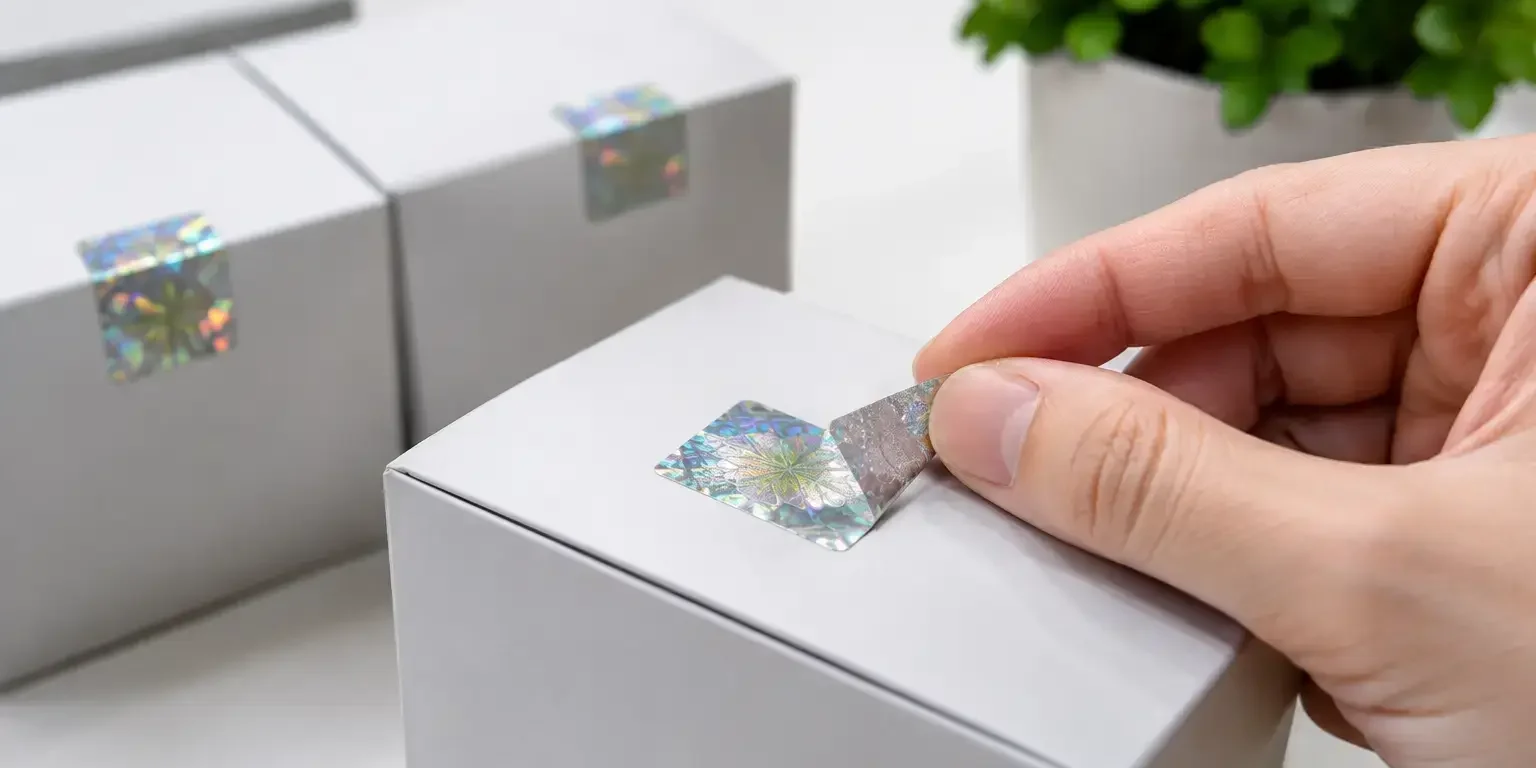
Hologram labels give an immediate visual indication that a label is not ordinary print. Their changing appearance under light is difficult to reproduce accurately using basic copying methods, which makes them valuable for branded products, warranty seals and higher-risk assets.
A standard holographic pattern offers visible deterrence at a sensible cost. A bespoke hologram incorporating a company name, logo or repeat design provides stronger brand-specific protection, as it is harder for an unauthorised supplier to imitate convincingly.
Holograms should not be treated as proof on their own. Sophisticated counterfeiters may use a generic holographic film to create the impression of security. Pairing a hologram with unique serialisation, a barcode or QR code, and tamper-evident material creates a more credible label.
Microtext and fine-detail printing
Microtext, fine line patterns and detailed artwork can make a label harder to reproduce on ordinary office equipment. At normal viewing distance, these features may look like a line or decorative element. Under magnification, genuine labels reveal readable text or a precise pattern.
This is a useful option where trained staff carry out inspections, such as on controlled stock, high-value components or warranty seals. It is less useful if the label will only ever be checked casually by the public, because the feature must be easy enough for the intended verifier to recognise.
Fine-detail printing works best as one part of a broader design. It can be incorporated into borders, logos and background patterns without making the label difficult to read.
Colour-shifting and UV features
Colour-shifting inks and ultraviolet-reactive elements offer a higher level of visual verification. A colour-shifting device changes appearance at different angles, while UV elements are visible only under ultraviolet light.
These features are suited to controlled verification environments where staff can be provided with a UV torch or clear inspection guidance. They are often appropriate for secure documents, premium goods, controlled inventory and applications where a visible feature alone is not enough.
The practical limitation is obvious: if nobody has the means or time to inspect the feature, it adds little day-to-day value. Use UV or colour-shifting elements when the checking process supports them, rather than simply because they sound more secure.
Material durability matters as much as security
An anti-counterfeit feature has little value if the label fades, peels or becomes unreadable after a few months. Consider where the item is kept and how it is handled. Indoor office equipment may need a durable polyester label with a permanent adhesive. Outdoor plant, warehouse containers or equipment exposed to cleaning chemicals may require a more specialised material and protective laminate.
Heat, abrasion, solvents, moisture and ultraviolet exposure can all affect label performance. Label size also matters. Small labels leave limited room for a serial number, barcode, logo and security devices, so priorities need to be agreed early.
A specialist manufacturer can advise on material, adhesive and print layout before production. This is particularly useful for bespoke labels where an attractive design must also scan correctly and show clear evidence of removal.
Build verification into the label design
The strongest label can still fail if staff do not know what to look for. Make verification proportionate to the task. A warehouse operative may need to scan a code and see a matching asset record. A service engineer may need to confirm a serial number and check that a void seal is intact. A customer may only need to recognise a holographic feature and know where to report concerns.
Keep human-readable information clear. Do not bury the serial number in decorative artwork or make barcodes too small for the scanner being used. If labels will be applied across a large estate, establish rules for placement, recording and replacement. A replacement label should never quietly reuse an existing serial number.
For higher-risk items, retain a record of label ranges, application dates and the person or department responsible. This makes duplicate numbers and unexpected removals easier to investigate.
Choosing the right combination
For everyday asset identification, a durable polyester label with a company logo, unique serial number and barcode may be enough. For equipment that must not be opened without authorisation, add a void or destructible tamper-evident feature. For branded goods or valuable components at risk of substitution, a hologram and unique verification code provide an additional layer.
The aim is not to make a label needlessly complicated. It is to make fraudulent copying, transfer or substitution more effort than it is worth, while giving legitimate staff a fast and reliable way to check what they are handling.
Before placing an order, identify the item surface, operating environment, information to be encoded and who will verify the label. Those answers will point to the right combination of security features and help ensure the label remains useful long after it has been applied.