
A missing laptop, unreturned power tool or unaccounted-for projector is rarely just an inconvenience. It creates replacement costs, wasted staff time and an asset register nobody fully trusts. The barcode versus RFID decision affects how easily your team can identify equipment, complete audits and deter loss – but the more expensive technology is not automatically the better choice.
For most UK organisations, the right method depends on the number of assets involved, how they move, the environment they work in and the process staff will realistically follow. A well-specified barcode label can provide dependable control at a fraction of the cost of an RFID system. RFID becomes worthwhile where speed, volume and hands-free identification solve a genuine operational problem.
Barcode versus RFID: the practical difference
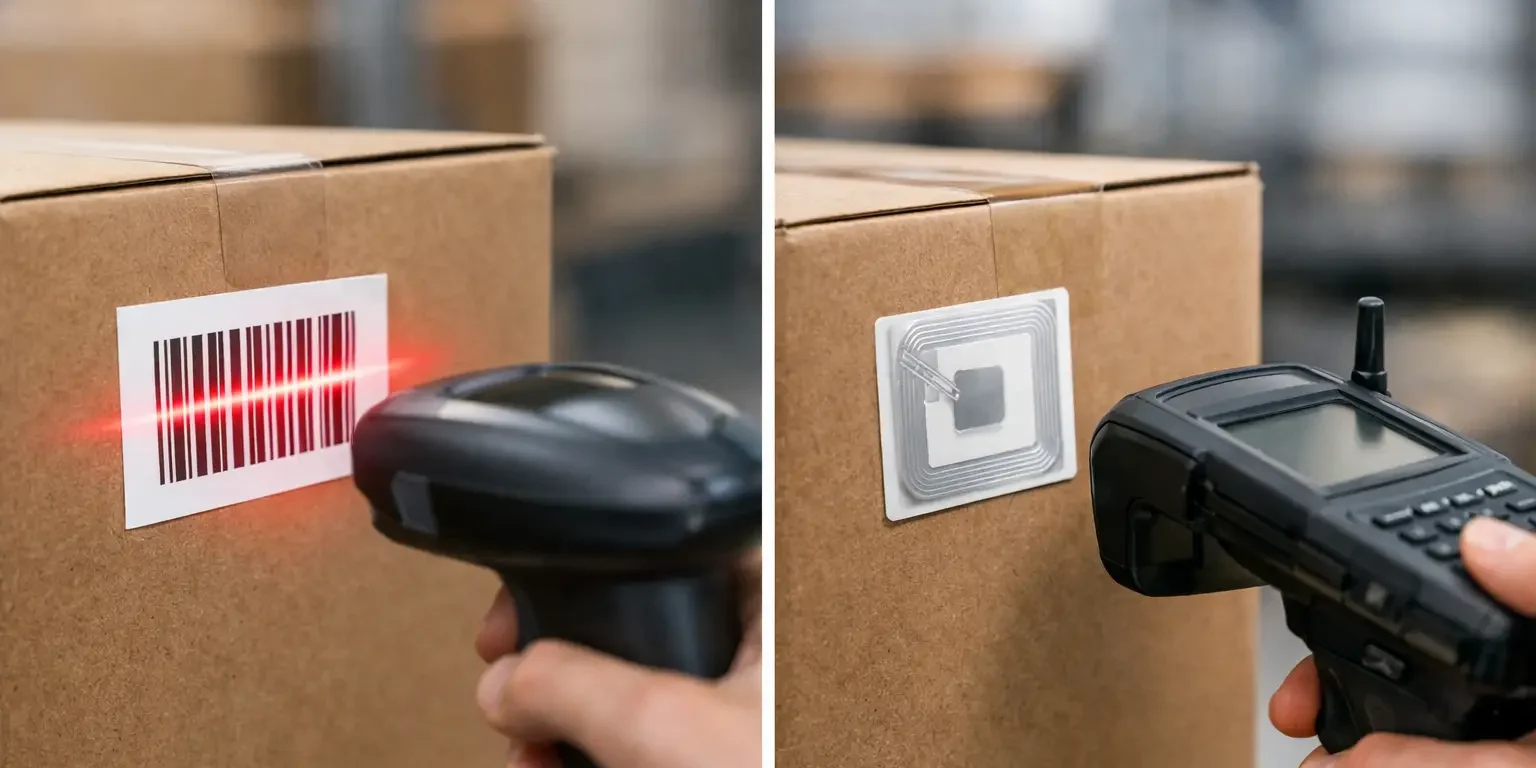
A barcode is a printed pattern that represents an asset number, serial number or other reference. A scanner, smartphone camera or dedicated mobile device reads the code when it is in sight. The scanned data is then matched to an asset register, inventory system or spreadsheet.
RFID, meaning radio-frequency identification, uses a small electronic tag containing a chip and antenna. A reader sends a radio signal to the tag and receives its stored identity in return. Depending on the RFID type, the tag can be read from a short distance or several metres away, without placing the reader directly in front of it.
That difference matters during stocktakes. With barcodes, each item must be found and scanned individually. With RFID, a user may be able to walk through a room or pass a reader near a cabinet and capture multiple tagged items quickly. However, RFID is a complete system, not simply a different kind of label. It requires compatible tags, readers, software and a process that accounts for its limitations.
Why barcodes remain the standard for fixed assets
For IT equipment, school resources, maintenance tools, furniture and office equipment, barcodes are usually the most cost-effective starting point. Labels are inexpensive, readers are widely available and the method works with most asset-management platforms.
A barcode also provides a visible instruction to staff: scan this item before issue, return or disposal. This direct action can improve accountability. When an asset is checked out to a person, location or department, scanning a clearly labelled barcode creates a deliberate record rather than relying on someone walking past a reader.
Barcode labels are simple to tailor. A label can combine a Code 128 barcode or QR code with a company name, asset number, serial number, return message and a warning that the item is security marked. This is particularly useful where an organisation needs both quick data capture and a clear theft-deterrent message.
The main limitation is line of sight. A dirty, scratched, obscured or poorly printed barcode may not scan. Labels therefore need to be selected for their working environment, rather than treated as a standard office stationery item. For long-term asset identification, durable polyester materials and permanent adhesives are often a sensible choice. Where removal should leave evidence, tamper-evident materials add a further layer of protection.
Barcode formats need to suit the scanner and system
There is no benefit in choosing a complex barcode symbology if the existing scanners or software cannot read it. Code 128 is a common choice for asset numbers because it is compact and supports letters and numbers. QR codes can hold more information and are easily scanned with mobile phones, but they need sufficient print size and contrast to remain reliable.
The underlying data must also be controlled. Each label needs a unique, accurate reference that matches the asset register. A perfectly printed barcode cannot fix duplicated numbers or records that have not been updated when equipment changes hands.
When RFID earns its higher cost
RFID is most useful when scanning individual labels takes too long or misses too many items. Hospitals, warehouses, large education estates, events businesses and organisations managing high volumes of reusable equipment may see a real return from quicker audits and improved visibility.
An RFID reader can identify several tags in a short period, making it practical to check a trolley of equipment, a storage room or a large batch of stock. Fixed readers at doorways can also support movement monitoring in tightly controlled environments, although this requires careful planning and is not a simple fit-and-forget measure.
RFID can be valuable for assets that are frequently moved between sites or departments. If teams spend hours each month locating equipment or reconciling inventory, reducing that effort may justify the investment. It can also reduce manual handling during routine counts, which helps where audit windows are short.
But radio signals do not behave identically in every setting. Metal surfaces, liquids, dense storage and closely packed equipment can affect read performance. Metal-bodied laptops, tools and machinery may need specialist on-metal tags, positioned and tested for the specific asset. The label price rises, and a site survey or trial becomes more important.
RFID tags can also be hidden or less obvious than barcode labels. That may suit some tracking applications, but it does less to visibly discourage theft. Organisations concerned with unauthorised removal may still want a prominent security or tamper-evident label alongside an RFID tag.
Cost is more than the price of a label
The unit price gap is significant. Printed barcode labels are affordable at scale and can be produced with bespoke numbering, logos and layouts. RFID tags contain electronic components, so their individual cost is higher before readers, software configuration and installation are considered.
A fair barcode versus RFID comparison should include the full operating cost. Consider the labels or tags, handheld or fixed readers, software integration, staff training, replacement labels, test time and the hours spent on audits. Then compare those costs with the value of time saved, fewer missing items and better compliance.
For a small business with a few hundred fixed assets, barcode scanning is normally easier to introduce and maintain. For a large organisation completing frequent audits across multiple locations, RFID may repay its cost over time. There is also a middle ground: use barcodes for most assets and reserve RFID for high-turnover, high-value or hard-to-count items.
Security, durability and label placement matter
Neither barcode nor RFID prevents theft by itself. Both identify an item and support an audit trail. The security result comes from combining identification with proper asset records, issue procedures and labels that are difficult to remove without evidence.
For valuable equipment, a tamper-evident barcode label can be particularly effective. If someone attempts to remove it, the face material may fragment, leave a patterned residue or show a visible VOID message, depending on the material selected. This makes interference obvious and discourages casual resale of marked equipment.
Durability needs equal attention. Office laptops and AV equipment usually need a label that resists normal handling and cleaning. Outdoor equipment, plant, workshops and industrial sites may require stronger adhesives and materials that cope with moisture, abrasion, oil, temperature changes and rough surfaces. Curved, textured or powder-coated surfaces can require a different adhesive from a smooth desktop computer.
Placement should be practical as well as secure. Put a barcode where it can be scanned without moving the asset, but avoid vents, opening panels, high-wear corners and areas likely to be cleaned aggressively. RFID placement should be tested with the intended reader, especially on metal items. A label that looks correctly positioned may still give inconsistent reads.
How to choose the right approach
Start with the asset process, not the technology. Ask how often equipment is counted, whether staff need to scan individual issue and return events, how many items are involved, and what failure would cost. A once-yearly count of office equipment does not have the same requirements as daily movement of medical devices or hire equipment.
Barcodes are usually the right choice where budgets are controlled, assets are individually issued, and staff can reasonably scan items one at a time. They are straightforward, compatible and highly effective when paired with durable custom labels and accurate records.
RFID deserves consideration where bulk reading will materially reduce labour, assets move rapidly, or the number of items makes manual scanning impractical. Before committing, test representative tags on the actual equipment and in the actual environment. Read range claims on a product specification are not a substitute for site testing.
Security-Label.co.uk can produce bespoke barcode and tamper-evident asset labels with sequential numbering, logos and layouts tailored to your register and working conditions. The key is to specify the information, material and adhesive around the job the label must do.
The most useful label is the one your team can scan reliably, leave in place for the asset’s working life and trust when audit day arrives.