A removed seal on a laptop, meter cabinet or medical case should leave a clear answer: has somebody accessed this item? That is the central distinction in tamper labels vs hologram labels. Both can deter interference and make equipment look more secure, but they solve different problems. Choosing on appearance alone can leave an asset, warranty process or access-control procedure exposed.
For most organisations, the right choice starts with the risk being managed. If you need proof that a label has been lifted or a case has been opened, a tamper-evident label is usually the proper starting point. If you need a visible mark that is difficult for an unauthorised party to reproduce, hologram labels may be the better fit. In some applications, using both provides the clearest level of protection.
Tamper labels vs hologram labels: the practical difference
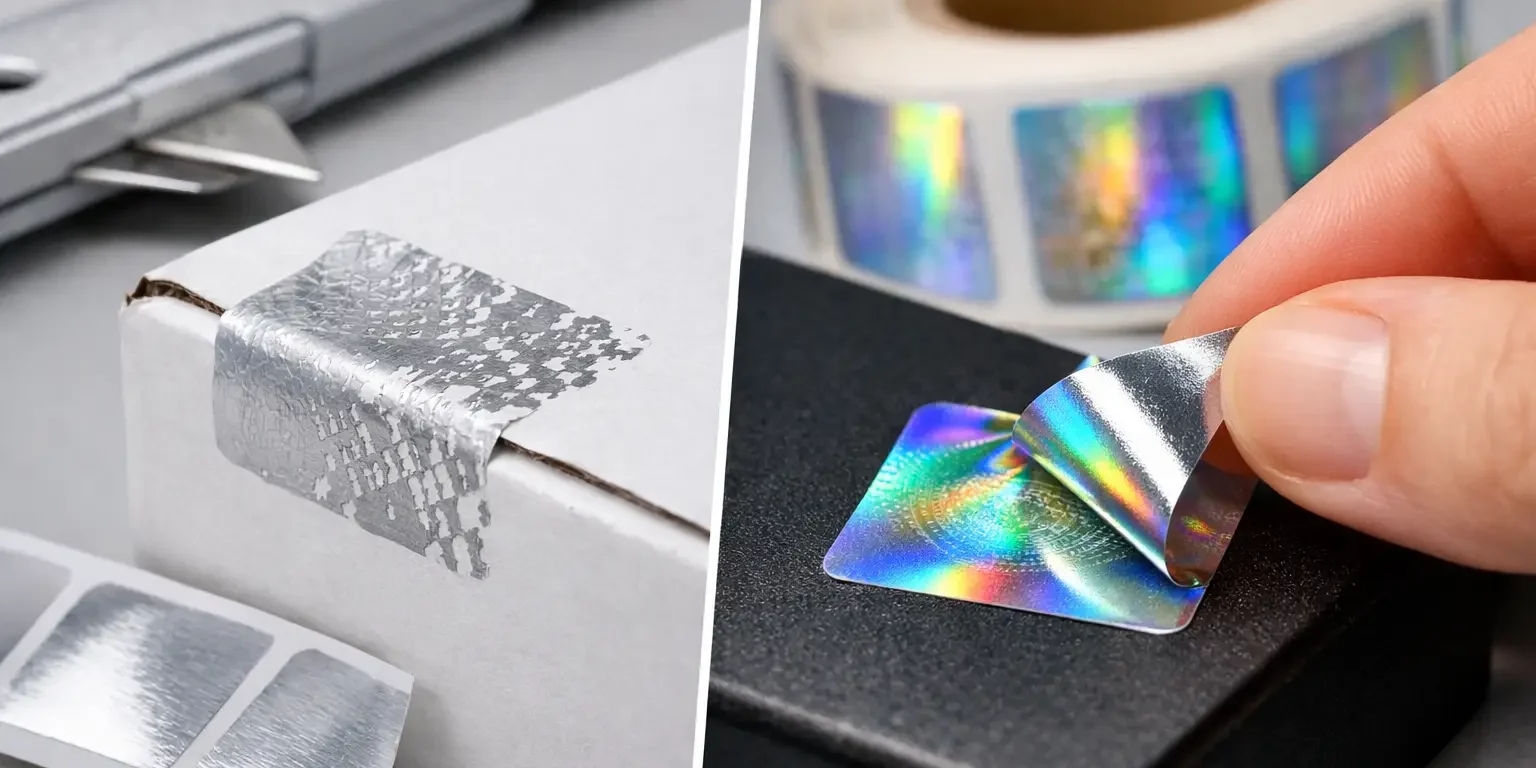
Tamper labels are designed to show evidence of interference. Once applied, they change visibly when somebody attempts to remove them, break the seal or open the protected item. Depending on the material, the label may leave a permanent residue such as VOID or OPENED on the surface, split into layers, tear on removal or reveal a hidden pattern.
Their purpose is accountability. A facilities manager can see whether a fire safety cabinet has been opened. An IT team can identify whether a desktop PC, server or network appliance has been accessed outside an approved maintenance process. A warranty department can assess whether a product has been opened before a claim is considered.
Hologram labels use a reflective, optically variable design. Their appearance changes with the viewing angle and light, making the label more distinctive than standard printed stock. Custom holograms can incorporate a logo, repeated text, serial numbers or other visual elements that make copying more difficult.
Their main purpose is authentication and deterrence. They help a buyer, inspector or member of staff recognise an authorised item or seal and make straightforward counterfeiting less attractive. A hologram does not automatically show that a product has been opened, however. Unless it is specified with a tamper-evident construction, it may be removed without providing the evidence that a security seal is expected to give.
When tamper-evident labels are the better choice
Tamper labels are most suitable where unauthorised access is the primary concern. Common uses include warranty seals on electronic equipment, access seals on electrical enclosures, calibration labels, security seals for cases and containers, and labels across a join or opening point.
The material matters as much as the wording. A destructible label is intended to fragment when removal is attempted, which makes it useful where a clean lift is unacceptable. A void label leaves a visible message on the label, the surface or both. This is often a practical option for equipment housings, asset cases and boxes because the evidence is obvious at a glance.
Surface condition must be considered before ordering. Smooth, clean plastic, coated metal and glass generally provide reliable adhesion. Rough powder-coated surfaces, textured plastics, oily equipment or outdoor applications may require a different adhesive or material. Applying even the best tamper label to a dusty or unsuitable surface can result in poor performance and may allow removal without the intended evidence.
For asset management, tamper labels can also carry a unique serial number, barcode or QR code. This links the physical item to an asset register while making label substitution more difficult. If a label is removed or damaged, staff have both a visible warning and an identification reference to investigate.
When hologram labels make more sense
Hologram labels are a strong option when brand protection, authenticity or resale risk is the concern. They are often used on branded products, certificates, approved consumables, event passes, controlled stock and high-value components. The visual effect acts as a deterrent because it signals that the item has an added security feature.
A standard generic hologram can provide a useful visual cue at a lower cost, but it should not be treated as high-level anti-counterfeit protection. Generic designs can be sourced by others. A bespoke hologram with your organisation’s logo or unique artwork is harder to imitate and gives staff a clear feature to check.
This is particularly useful where assets or goods move between sites, suppliers or customers. A procurement team may use a custom hologram to identify approved equipment. A school or council may apply them to valuable devices to make ownership clear and discourage opportunistic theft. A service department may use holograms to distinguish genuine parts from unapproved replacements.
Hologram labels can also include variable data. Consecutive numbering, barcodes and QR codes provide a route to inventory records, audits or product verification processes. The holographic effect adds a visual layer of security, while the printed data supports operational control.
Where a combined label is worth considering
The strongest solution is not always one label type or the other. A holographic tamper-evident label combines visible authentication with evidence of removal. It is suitable where a seal must look official, resist casual copying and show interference clearly.
Consider an IT equipment supplier applying warranty seals to laptops or specialist devices. A plain void label can show that the casing has been opened. A custom holographic void label can do the same while also displaying the supplier’s identity, a serial number and a feature that is more difficult to copy. The added cost may be justified where the equipment has high value or is regularly handled by third parties.
The same principle applies to controlled access points. A tamper-evident hologram can be placed across the closure of a cabinet, box or instrument case. Staff can check the seal’s condition, while an auditor can identify whether the seal is genuine and allocated to the correct item.
There is still a trade-off. Combining features increases specification and unit cost, particularly for small runs or highly bespoke artwork. For straightforward internal sealing, a conventional void label is often the most cost-effective option. For externally distributed products or equipment where imitation is a realistic concern, the additional security can be worthwhile.
Factors to specify before placing an order
Security labels work best when they are specified for the actual application rather than selected from a photograph. Start with the surface, environment and expected lifespan. Indoor office equipment needs a different construction from outdoor plant, refrigerated stock or items exposed to cleaning products.
Think about what staff need to see after interference. A large VOID message may be ideal for a plant room enclosure, but too conspicuous for a small consumer product. Destructible material may provide better evidence on a smooth surface, while a residue-transfer label can be easier to inspect during routine checks.
Next, decide whether the label needs identification data. Asset numbers, sequential serials, barcodes and QR codes can all be incorporated into a label layout. For organisations using scanners, the barcode format should be selected to match existing hardware and software. A code that cannot be scanned reliably offers little value, even if the label itself is secure.
Artwork should also be practical. Company logos, contact details, warning text and instructions can all help, but small labels have limited space. Keep the information that supports security and recovery, then avoid overcrowding the design. Clear text and a scannable code are usually more useful than decorative detail.
Finally, consider replacement and inspection procedures. A seal is only effective when staff know what to do if it is damaged, missing or does not match the recorded serial number. Record the label number at installation where appropriate, define who can authorise a replacement, and make seal checks part of routine asset or safety inspections.
A practical choice for UK organisations
For equipment access, warranty control and proof of interference, choose a tamper-evident label designed to leave visible evidence. For brand authentication and an added barrier against copying, choose a hologram label with distinctive artwork and variable data where required. Where both risks apply, specify a holographic tamper label rather than relying on either feature alone.
Security-Label.co.uk manufactures security labels in the UK and can advise on material, adhesive, numbering and barcode requirements before production. That support is particularly useful when labels need to work across mixed equipment, multiple sites or an established asset register.
The best label is the one that gives your team a simple, reliable decision when they inspect an item: this seal is intact, this asset is identified, and any attempted interference is immediately clear.