A label that falls off a laptop, cannot be scanned, or can be removed without a trace does not protect the asset it was intended to identify. When you order bespoke security labels, the useful questions are not only about size and price. You need to consider where the label will be used, what information it must carry, how long it must last and whether tamper evidence is required.
For organisations managing IT equipment, tools, school devices, laboratory instruments, furniture or stock, a properly specified label supports day-to-day control as well as audit and insurance requirements. The right choice makes assets easier to identify, assign, trace and recover. The wrong one creates another administrative problem.
Start with the job the label needs to do
Bespoke security labels are not a single product. An asset label for office monitors has different requirements from a seal used to show unauthorised access to a cabinet or electrical enclosure. Defining the application first prevents unnecessary cost and avoids selecting a material that is unsuitable for the environment.
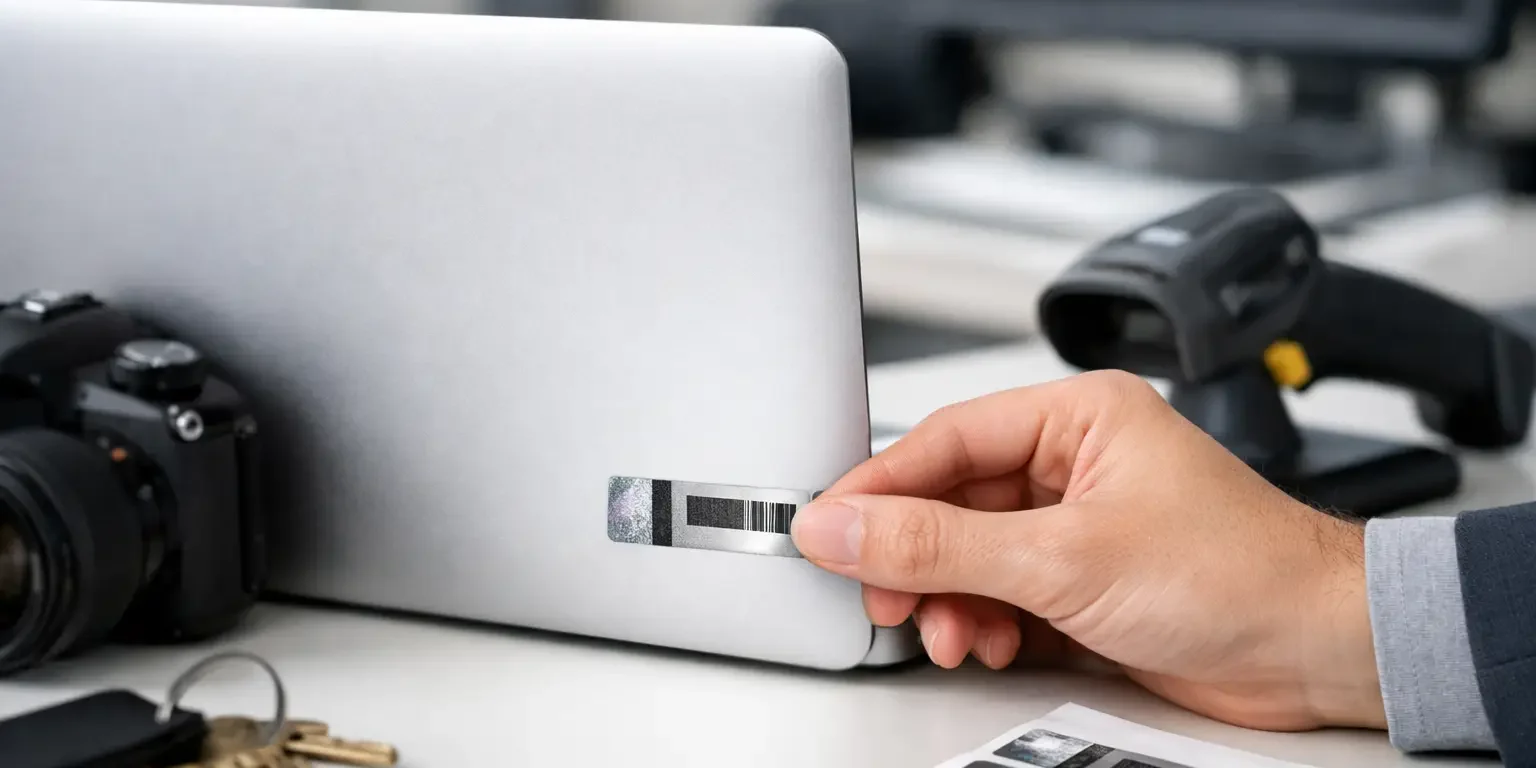
For fixed asset management, the priority is usually permanent identification. Labels need to stay attached, remain readable and work with an asset register. A serial number, barcode or QR code can connect the physical item to its record, making stock checks and handovers quicker.
For loss prevention, visible labels can act as a deterrent. A label printed with your company name, unique numbering and a clear ownership message makes equipment less attractive to remove and harder to pass on unnoticed. Where removal is a concern, tamper-evident materials add a further level of protection.
For security sealing, the focus changes. A tamper-evident seal should show clear evidence if somebody has attempted to open, remove or interfere with protected equipment. Depending on the material selected, it may leave a residue, reveal a hidden message such as VOID, or break apart on removal.
Choose a material that suits the asset and environment
Adhesive performance is often where generic labels disappoint. The surface of the asset, exposure to heat or moisture, cleaning routines and expected lifespan all affect the specification.
Paper labels can be suitable for short-term identification or controlled indoor use, but they are rarely the best choice for valuable equipment or long-term records. Polyester is a common choice for durable asset labels because it offers good resistance to scuffing, moisture and everyday handling. It is well suited to laptops, PCs, monitors, printers and office equipment.
For curved, textured or difficult surfaces, the adhesive matters just as much as the face material. Powder-coated metal, low-energy plastics, rough-painted tools and outdoor equipment may require a more aggressive adhesive. If labels will be exposed to cleaning chemicals, oils, cold stores or outdoor weather, say so at the quotation stage. A small detail about the working environment can determine whether the label stays in place for years or starts lifting at the edges within weeks.
Tamper-evident materials involve a trade-off. A destructible vinyl label offers strong evidence of removal because it breaks into small pieces, but it cannot normally be repositioned. A void label may provide a clearer visual warning, but the residue and reveal effect should be selected for the surface and application. If an asset may need to be refurbished or reassigned later, discuss whether a permanent tamper label, a standard durable label, or a combination of both is most practical.
Size and layout should support fast identification
A label has limited space. Cramming in a logo, long company address, barcode, QR code, serial number and instructions can make the important information too small to read or scan.
A good layout places the asset number first, followed by the barcode or QR code and only the supporting information needed by your team. Larger labels are easier to scan from a distance and more forgiving where equipment is handled frequently, but they must fit a flat, visible area. On compact devices, a smaller label may be necessary, provided the barcode remains large enough for reliable scanning.
If you use a handheld scanner, test the chosen barcode format against the devices and software already in use. This is particularly important where labels are small or where staff scan in low-light plant rooms, storerooms or busy classrooms.
Match barcode data to your existing system
Barcodes reduce transcription errors and speed up asset checks, but only when the code matches the system behind it. Before placing an order, identify the data your software expects and whether numbering needs to run in sequence.
Code 128 is widely used for alphanumeric asset numbers and offers good data density. QR codes can hold more information and can be scanned with many mobile devices, making them useful where staff use phones or tablets for audits. A QR code may point to an internal asset record or simply contain the asset ID. The best option depends on your software, security policy and scanning process.
Do not assume every QR code should contain a web address. For many organisations, a simple unique identifier is safer and easier to manage. It keeps the label useful even if an internal system changes, as long as the asset ID remains in the register.
Variable data must also be checked carefully. Provide a clear numbering range, prefix format and any required check digits. For example, IT-000001 to IT-002500 is different from a plain 1 to 2500 sequence. A sample proof is the opportunity to catch a missing zero, an incorrect prefix or barcode data that does not match your spreadsheet.
Decide how much tamper evidence is proportionate
Not every asset needs the highest level of tamper protection. Standard durable labels are often appropriate for desks, chairs, monitors and lower-risk inventory. They identify ownership clearly and support routine audits at an economical cost.
Higher-value portable equipment, sensitive electronics, electrical cabinets and controlled stock may justify tamper-evident labels. These labels do not physically stop theft, but they make interference visible and help establish accountability. Used alongside an up-to-date register, secure storage and clear issue-and-return procedures, they form part of a practical control system.
It is worth being realistic about what a security label can achieve. A determined person can remove almost any label given enough time and the right tools. The value lies in deterrence, evidence and identification – not in treating a label as a substitute for physical security or sound asset procedures.
Prepare your order information before requesting a quote
A straightforward brief helps production move quickly and reduces the chance of revisions. Include the label dimensions, quantity, material preference if known, print colours, logo artwork and the exact variable data required. If you are unsure about material, describing the asset surface and environment is more useful than guessing.
For numbered labels, provide the required sequence and state whether every label must be unique. For barcodes and QR codes, include the code type and confirm what each code should contain. If labels are being applied across several sites or departments, consider whether prefixes should identify location, team or asset category.
Artwork should be supplied in a clear, usable format where possible. However, bespoke manufacture should not require you to become a print specialist. A manufacturer with experience in asset and security labels can advise on practical label sizes, barcode readability, spacing and material suitability before production begins.
Check a proof before production
The proof stage is not a formality. It is where you confirm logo placement, wording, barcode content, serial number sequence and overall layout. Check it against the actual asset register rather than relying on memory or an old spreadsheet.
Where the application is unusual, a sample can be worthwhile. Applying a label to the real surface and leaving it in normal conditions gives confidence before committing to a larger run. This is particularly sensible for outdoor equipment, high-temperature areas, heavily cleaned surfaces and textured plastics.
Consider total value, not just unit price
Low minimum quantities can be useful for pilot schemes, departmental orders or specialist equipment, while larger volumes generally reduce the price per label. The cheapest label is not necessarily the best value if it needs replacing, cannot be scanned or causes delays during an audit.
UK manufacture can also make a practical difference when deadlines are tight. Clear communication, accurate proofs and fast turnaround reduce the risk of receiving labels that are technically printed correctly but unsuitable for the assets they were ordered for.
Security-Label.co.uk produces bespoke labels in Scotland for organisations that need durable identification, serialisation, barcode printing and tamper-evident options without unnecessary complexity. The most effective order begins with a clear account of the asset, the environment and the process the label must support – then the label can do its job reliably long after it has been applied.