
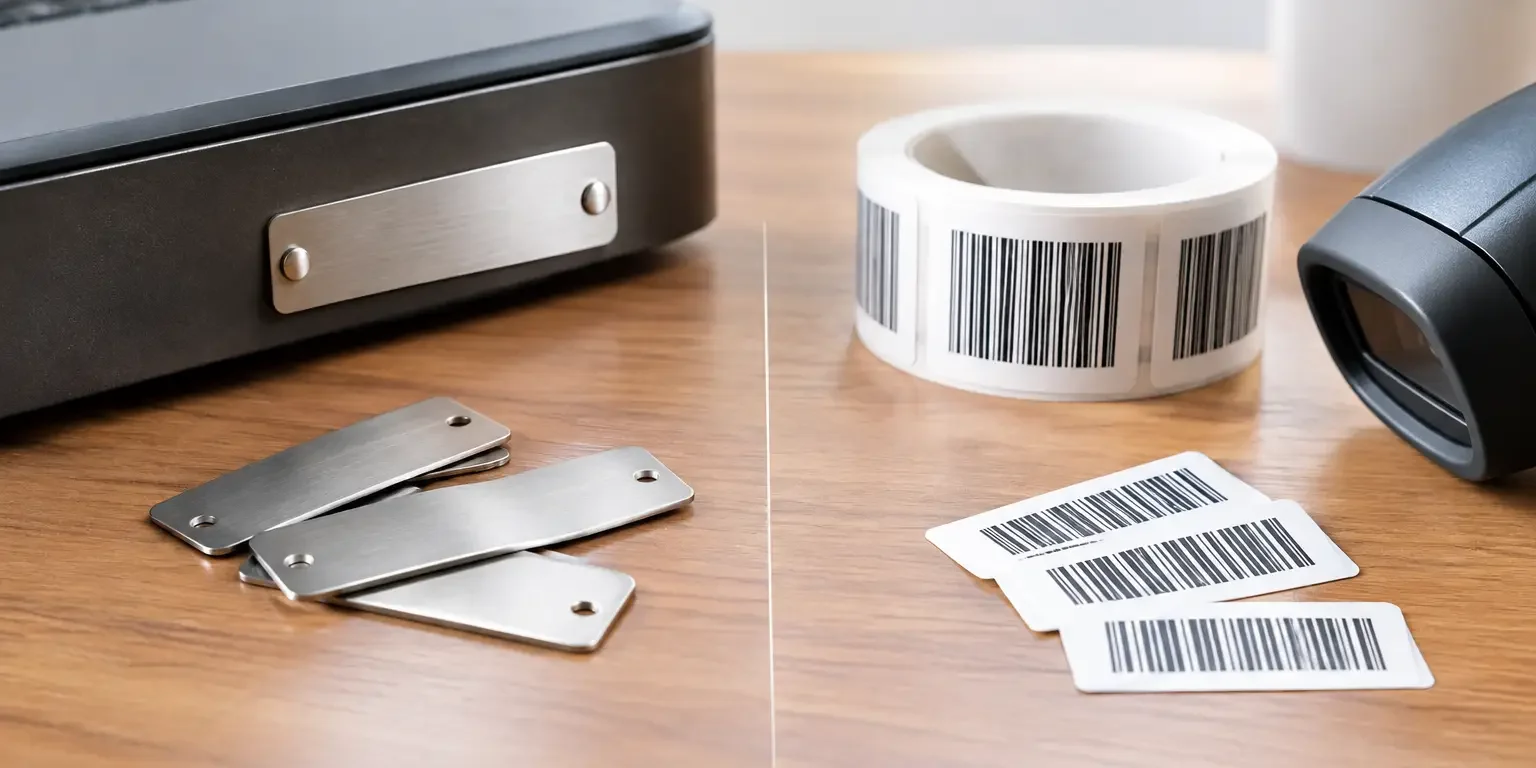
A missing laptop is not always a theft problem. It may be an identification problem: a paper barcode has worn away, two devices carry the same description, or nobody can match an item to the asset register. When considering asset tags vs barcode stickers, the right choice depends on how long the item will be in service, where it is used and what you need the label to prove.
A barcode sticker can be a perfectly practical, low-cost answer for stock, short-life equipment and controlled indoor locations. An asset tag is usually the better long-term choice for valuable equipment that must remain identifiable through moves, cleaning, handling and audits. The two are not mutually exclusive. In many cases, an asset tag includes a barcode as part of its printed design.
Asset tags vs barcode stickers: the practical difference
The key difference is purpose. Asset tags are designed to identify a specific, fixed asset over its working life. They commonly carry a unique serial number, company name, barcode or QR code, and sometimes a warning message such as “Property of”. They are normally made from durable materials with an adhesive chosen for the surface and environment.
Barcode stickers are primarily designed to hold machine-readable data. They may identify an individual item, batch, location or stock keeping unit, but they do not automatically provide the physical durability or theft deterrence expected from an asset label. A standard printed barcode can be placed on almost any label stock, from economical paper to hard-wearing polyester.
This distinction matters because a barcode system is only as reliable as the label at the point of scanning. If the barcode becomes scratched, lifts at the corners or fades after cleaning, the data may still exist in your software, but the connection between the equipment and its record has been lost.
When barcode stickers are the sensible option
Barcode stickers work well when fast, economical identification is the priority. For example, a warehouse may use them for cartons, shelf locations, consumables, hired equipment or stock that moves quickly through the business. They can also be useful for an initial asset audit where hundreds or thousands of items need to be labelled within a tight budget.
For indoor applications with limited wear, a good-quality synthetic barcode label can last well and scan reliably. The label should be sized to suit the scanner, printing resolution and amount of encoded data. Very small labels with dense barcodes can be difficult to scan, especially on curved equipment or in poor light.
Barcode stickers are less suitable where assets are frequently handled, exposed to oils or solvents, kept outdoors, or cleaned with chemicals. They may also be the wrong choice for devices at higher risk of loss. A plain barcode gives a finder little reason to return an item and offers no obvious evidence if somebody attempts to remove it.
Why asset tags suit long-term equipment control
Asset tags are built around accountability. A properly specified tag gives each item a visible identity that remains attached for years, not just until the next stocktake. This is particularly useful for IT equipment, tools, plant, laboratory equipment, school resources, medical devices, office furniture and AV equipment.
A serialised asset tag lets your team confirm an item without relying on a vague description such as “Dell laptop” or “projector in meeting room two”. Add a barcode or QR code and staff can scan directly into an asset management system, spreadsheet or inventory app. The human-readable number remains available if the scanner is unavailable or the barcode is damaged.
Asset tags can also deter casual theft. A clearly marked label showing ownership makes equipment less attractive to remove and harder to pass on unnoticed. Where stronger protection is required, tamper-evident asset labels leave a visible message, pattern or residue when removal is attempted. This does not make theft impossible, but it makes interference apparent and can support internal investigations, insurance records and audit controls.
Durability is not just about the label material
Many buyers ask for a “durable asset label”, but durability comes from the full specification: face material, adhesive, print method, laminate and the surface to which it is applied. Polyester is a common choice for indoor assets because it is tough, stable and resistant to general wear. For more demanding conditions, specialist materials may be needed to tolerate heat, moisture, UV exposure, abrasion or cleaning agents.
The adhesive is equally important. A label that performs well on smooth, clean powder-coated metal may fail on textured plastic, rubberised cases, oily machinery or low-energy plastics. Curved surfaces can also put pressure on the edges of a rigid label. Providing details of the equipment surface and environment before ordering avoids costly relabelling later.
Print quality deserves the same attention. Barcode contrast, quiet zones around the code and resistance to scratching all affect scanning performance. If an asset will be used in workshops, kitchens, hospitals or outdoor sites, test samples on the actual surface where possible. A label that looks fine when first applied is not necessarily suitable after six months of use.
Security and tamper evidence: where the decision changes
If your main concern is stock identification, a barcode sticker may be enough. If you need to know whether a label has been removed or substituted, use an asset tag with a tamper-evident feature instead. These labels are made to break apart, reveal a void message, leave a residue or otherwise show signs of removal.
Tamper evidence is particularly valuable for portable IT, calibrated equipment, safety devices, leased assets and items stored in shared areas. It can also prevent a label being moved from a legitimate asset to an unmarked item. The appropriate construction depends on whether you need a visible warning on the asset, residue on the surface, or both.
There is a trade-off. Tamper-evident labels are not normally intended to be moved or reused, so they are unsuitable for equipment that regularly changes ownership or requires a removable identification label. In those cases, a durable non-tamper asset tag, backed by a clear asset register, may be more practical.
Barcode, QR code or serial number?
An asset tag does not need a barcode, but most organisations benefit from combining formats. A plain sequential serial number is simple and easy to read during a manual audit. A 1D barcode is efficient where existing scanners and software use established barcode formats. A QR code can hold more data in a smaller space and is convenient when staff use mobile phones for scanning.
The best code is the one your current process can read reliably. Do not select a QR code simply because it appears modern if your asset system is built around 1D barcode scanners. Equally, do not squeeze a long serial number into a small linear barcode where a QR code would provide more reliable scanning.
Keep the label data focused. A unique asset number, business name and readable barcode are often enough. Including a department, site name or contact details can help, but too much information makes a small tag cluttered and reduces barcode size. The asset register should hold the detailed record, including purchase date, user, location, value and maintenance history.
Cost: look beyond the unit price
Barcode stickers generally cost less per label, particularly for high-volume internal stock control. They may be the right financial decision where labels are expected to be replaced regularly or the items themselves have a short useful life.
However, the lowest label price is not always the lowest operating cost. Replacing failed labels, investigating unidentifiable equipment and repeating a physical audit can cost far more than choosing a suitable asset tag at the outset. For valuable or long-life items, a tougher label with serialisation and a scannable code is usually easier to justify.
Consider the total requirement before requesting a quote: number of assets, label size, surface type, indoor or outdoor use, barcode format, consecutive numbering, logo, security feature and required delivery date. A specialist manufacturer can advise on a specification that avoids paying for unnecessary features while still meeting your audit and security needs.
Choosing the right label for your assets
Start with the asset, not the artwork. Ask how long it will remain in service, what it is made from, who handles it, how it is cleaned and what happens if it goes missing. Then decide whether you need simple scanning, permanent identification, visible ownership marking or evidence of tampering.
For temporary stock and protected indoor use, barcode stickers are often the efficient choice. For laptops, tools, equipment and other assets that must remain traceable over time, durable asset tags with unique numbering and a barcode offer stronger control. Where label removal itself is a risk, add a tamper-evident construction.
The useful test is simple: choose the label you would still trust to identify the asset at the next audit, not merely the one that looks acceptable on the day it is applied.